

Hologram Fan Displays: What Content Actually Works
The article is written by a human. Mistakes have been edited by AI. Specifications taken from manufacturer product pages and documentation, checked August 2026. Pixel density figures are calculated from published resolution and diameter — the method is shown so you can check it.
The most common way a hologram fan display fails has nothing to do with the fan. A brand buys one, mounts it in a retail window, and loads the 16:9 product film they already own. Half the image is cut off by the circle. The background is grey rather than black, so a faintly glowing disc hovers behind the product. The logo is 40 pixels tall and unreadable. The client concludes the technology is a gimmick. The technology is fine. The content was made for a rectangle with a background, and a hologram fan is a circle with no background. This article is about the difference, in numbers.
Who this article is for: anyone producing content for a hologram fan, and anyone about to buy one and wondering what they will have to feed it.
What it solves: every guide repeats “use a black background” and stops. None of them tell you the pixel density you are working at, how much of the disc a 16:9 clip wastes, or why 60 fps can cost you resolution.
What you get by the end: calculated pixel density for real devices, the minimum size anything can be, the circle geometry in numbers, five content rules, a conversion workflow, and the safety points nobody prints.
Hello dear artists and clients of LIME ART GROUP. I am new media artist Alexander Kuiava. We produce content for these displays, so the rules below come from files that had to work on real hardware.

What the device physically is
A hologram fan is a set of LED strips mounted on rotor arms, spinning fast enough that persistence of vision fuses them into a continuous disc of light. There is no screen and no projection. Each LED is switched on and off with precise timing as it passes through each angular position, and your eye assembles the result.
Three consequences follow, and everything else in this article comes out of them.
The image is a disc. Not a square, not a 16:9 rectangle. Content outside the inscribed circle does not exist.
Black is not a colour, it is off. There is no backlight and no panel. Where the content is #000000, the LEDs simply do not fire, and the viewer sees the wall behind. This is why the floating effect works, and it is also why the contrast ratio on these devices is quoted at figures like ≥2,000,000:1 — the “black” is genuine absence of light. There is no alpha channel anywhere in the pipeline. Transparency is achieved by being black, and only by being black.
Angular resolution falls off toward the rim. The LEDs are spaced along the radius, so along the direction of rotation, sample spacing grows in proportion to distance from the centre. At the outer edge of the disc, tangential pixel spacing is roughly twice what it is at half radius. Fine detail survives near the centre and dissolves at the edge. This is geometry, not a manufacturing flaw, and it is true of every fan ever built.
The four numbers that decide your content
Every decision about hologram fan display content comes back to four specifications. Manufacturer marketing quotes diameter and resolution, and neither on its own tells you what will be legible. The number that does is pixel density, and almost nobody publishes it — so here it is, calculated from published specs.
| Device | Image diameter | Resolution | Calculated PPI | Equivalent pixel pitch |
|---|---|---|---|---|
| HYPERVSN SmartV Solo M | 56 cm / 22″ | 880 px | 40 PPI | 0.64 mm |
| HYPERVSN SmartV Solo L | 75 cm / 30″ | Full HD (1080 px) | 37 PPI | 0.69 mm |
| HYPERVSN SmartV Wall unit @ 30 fps | 75 cm | 1020 × 1020 | 35 PPI | 0.74 mm |
| HYPERVSN SmartV Wall unit @ 60 fps | 75 cm | 880 × 880 | 30 PPI | 0.85 mm |
| SuperB SH-U65 | 65 cm / 25.6″ | 1280 × 1280 | 50 PPI | 0.51 mm |
| SuperB 100 cm | 100 cm / 39.4″ | 1184 × 1184 | 30 PPI | 0.85 mm |
The method: divide the pixel count across the diameter by the diameter in inches. Pitch is 25.4 divided by the PPI.
Two sanity checks that tell you the arithmetic is right rather than invented. HYPERVSN publishes an ultra-fine pixel pitch of under 0.65 mm for the SmartV — and 56 cm across 880 pixels works out at 0.636 mm. The numbers agree. And the calculation reproduces the manufacturer’s own figure from two unrelated published specs, which is the only reason to trust it.
Four things fall straight out of that table.
Holographic Videos
Subjects originated on genuine black – up to 4K, ready to crop square
-
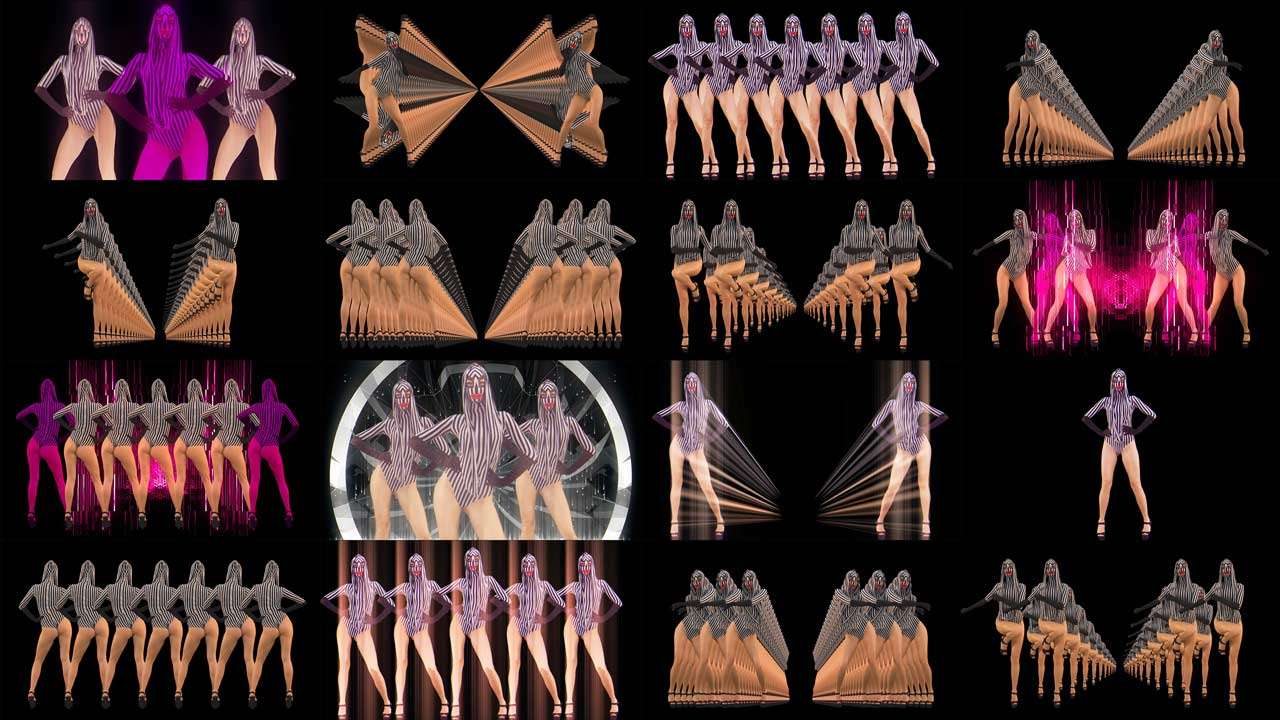
VJ Loops Pack Vol.17 – Main Element
99€ -
VJ Loops Pack Vol.3 – PolyMask
29€ -
VJ Loops Pack Vol.59 – Rave Ape Gorilla
89€ -
VJ Loops Pack Vol.62 – Smoke Girls
99€ -
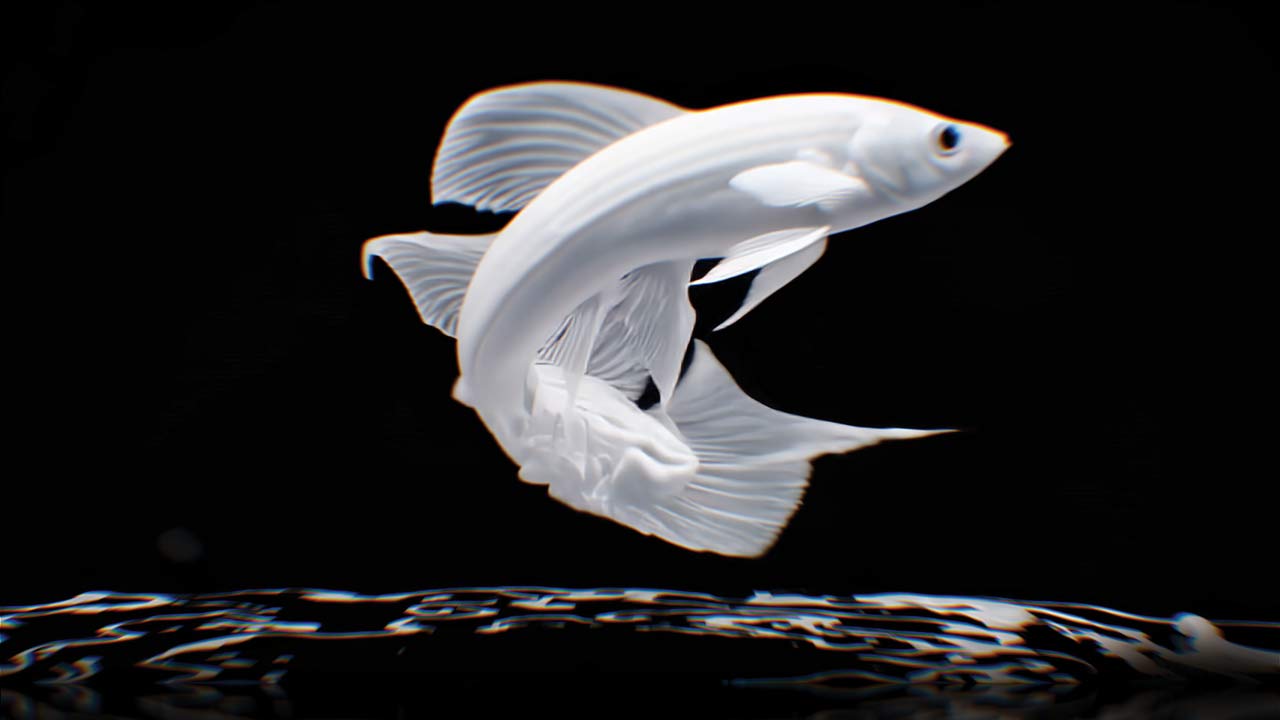
Fish Noir – AI VJ Loops Pack Vol.1
69€ -
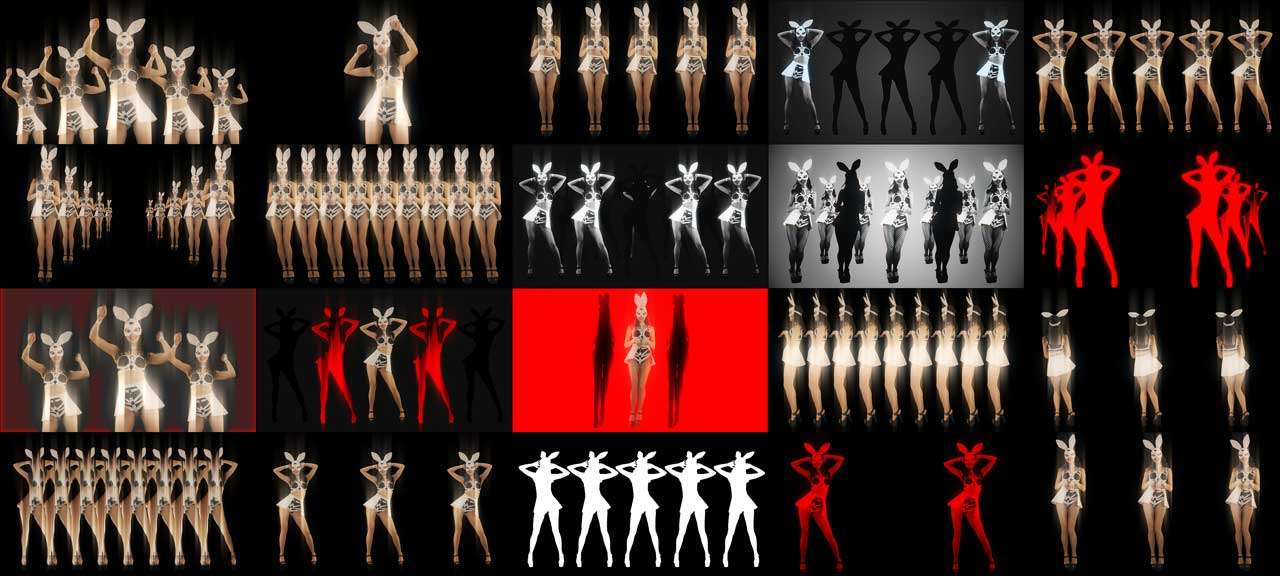
VJ Loops Pack Vol.68 – Bunny Honey
99€ -
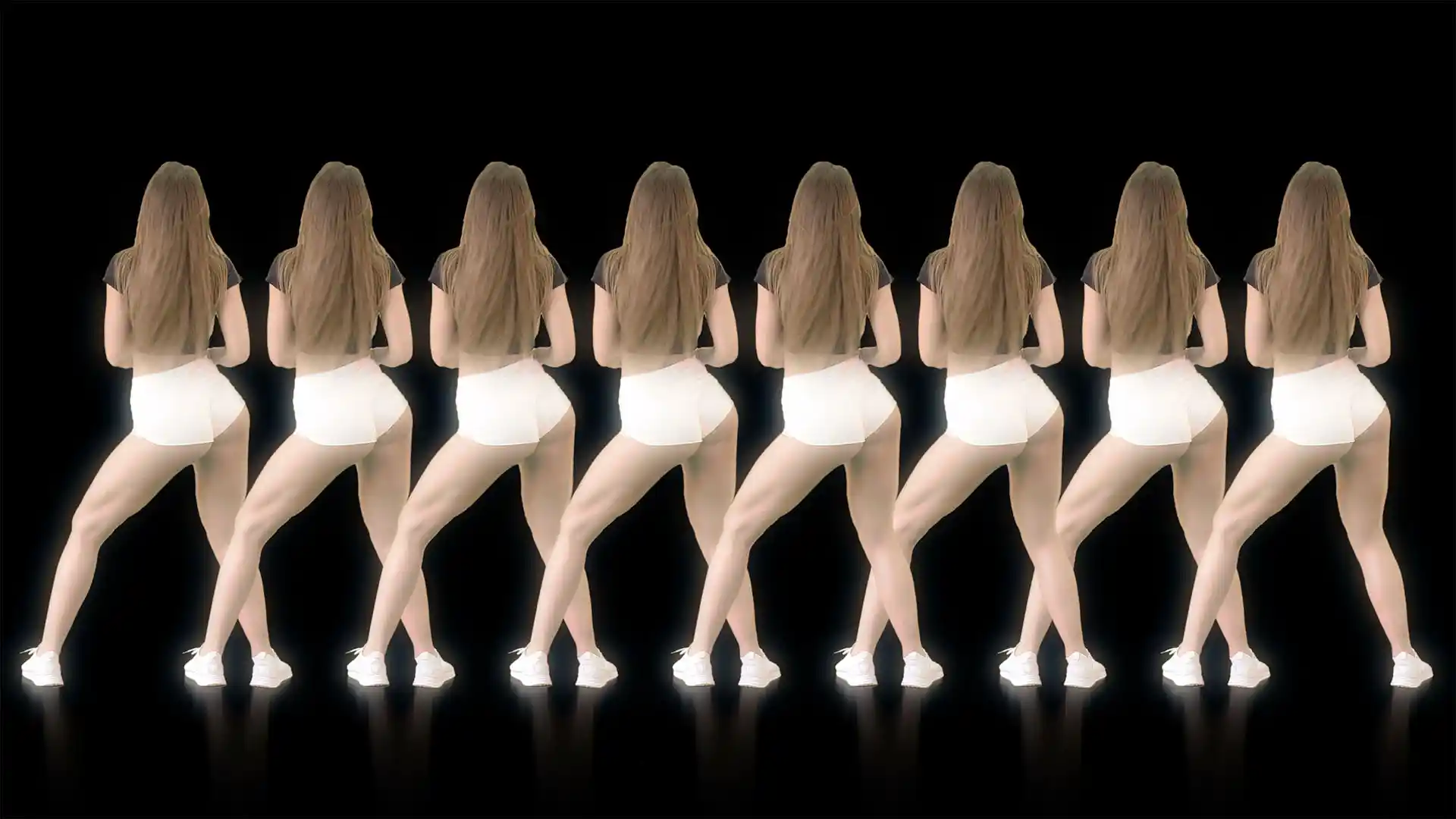
VJ Loops Pack Vol.71 – Twerkology
89€ -
Sale!
VJ Loops Pack Vol.73 – Mirror Ballet
Original price was: 129€.99€Current price is: 99€.









1. A bigger fan is not a sharper fan
Look at the SuperB pair. The 65 cm unit resolves 1280 pixels across; the 100 cm unit resolves 1184 across a diameter more than half again as large. The larger device is less dense: 50 PPI against 30. Going bigger buys you presence at distance, not detail. If you need the logo readable from three metres, the small fan is the better device.
2. You are working at roughly one tenth of phone resolution
For scale: a modern phone runs around 460 PPI. A 55-inch 4K television is about 80 PPI. A fine-pitch indoor LED wall at 2.5 mm pitch is about 10 PPI. Hologram fans land between the LED wall and the television, at 30 to 50.
The practical rule that follows: anything smaller than about 3% of the disc diameter will not read. On a 1024-pixel canvas that is roughly 30 pixels — so body text is out entirely, a wordmark needs to be a substantial element rather than a corner credit, and single-pixel outlines will shimmer rather than draw.
3. Frame rate costs you resolution
This is the specification most people never notice. The HYPERVSN wall unit runs 1020 × 1020 at 30 fps and drops to 880 × 880 at 60 fps — about 14% off the linear resolution, or a quarter of the total pixels, in exchange for smoother motion.
That makes frame rate a content decision rather than a default. Slow, detailed, mostly-static work — a rotating product, a floating logo, a slowly turning object — belongs at 30 fps where the extra pixels are visible. Fast motion, character animation and anything with rapid rotation belongs at 60 fps, where the extra pixels would have been smeared by movement anyway.
4. Brightness is not your constraint, ambient light is
These devices run at 2,600 to 3,200 cd/m². That is bright, and in a controlled interior it is more than enough. But the illusion depends on the surroundings being darker than the image. In a sunlit shop window facing south, a fan display becomes a dim spinning object with visible arms. Position it against a dark backdrop, or accept that it will only work after dusk.
What content actually works
Rule one: pure black, and truly pure
All hologram fan display content starts here: the background must be #000000. Not near-black, not a dark grey gradient, not a black with a slight vignette. Any pixel value above zero fires the LEDs, and because the eye is comparing that light against a genuinely unlit surround, even a value of 5 or 6 produces a faintly visible disc floating behind the subject.
This catches people out in specific and predictable ways:
- Compression lift. H.264 at a low bitrate does not preserve true zero. Blacks drift upward in the darkest regions and you get blocking around the subject’s edges. Encode at a generous bitrate and check the result on the device, not in your editor.
- Colour management. A file exported with the wrong transfer characteristics can arrive with lifted blacks even when the source was clean.
- Glows and lens flares. A soft glow around your subject is exactly the artefact you are trying to avoid. It reads as a halo, and the halo has a visible edge where it falls off.
- Alpha channels. They do nothing here. Files with transparency must be flattened onto black before export, and you should check what happened at the semi-transparent edges — feathered alpha over black produces a dark fringe that looks like a dirty cutout.
If you are adapting material from our alpha channel videos or green screen footage, that flattening step is where the quality is won or lost. Key generously, then check the edge against pure black at full brightness.
Rule two: compose in a circle, not a rectangle
The largest 16:9 rectangle that fits inside a circle is smaller than people expect. On a 1024-pixel disc it measures 892 × 502 pixels — which occupies 54% of the circle’s area. Drop a 16:9 clip into a fan and you have thrown away 46% of the display.
Worse, you have thrown away the wrong 46%: the top and bottom of the circle, which is exactly where a radiating composition would put its energy.
Design instead from the centre outward. The subject sits at or near the middle, where angular resolution is highest, and secondary elements orbit or radiate. Keep everything important inside roughly 85% of the diameter — the outermost band is the coarsest part of the image and is also where a mounting arm or safety cover is most likely to intrude.
Rule three: depth comes from rotation and scale, never from sliding
The disc is flat. Any impression of three dimensions is a monocular cue that you have deliberately drawn, and only some cues survive.
What reads as depth: an object rotating on its own axis, so that perspective and occlusion change; an object scaling as if approaching the viewer; overlapping elements passing in front of one another; motion blur consistent with speed.
What reads as a flat sticker: an object sliding left to right at constant size; parallax between flat layers; anything that relies on stereo separation, because there is none.
This is the single largest quality gap between content that was designed for a fan and content that was adapted onto one. A logo that spins in Z looks volumetric. The same logo drifting across the disc looks like a sprite.
Rule four: exploit the contrast, do not fight it
The one thing this display does better than any panel is absolute black. A saturated, high-contrast subject on nothing is spectacular. A busy, evenly-lit, full-frame composition throws that advantage away and turns the fan into a low-resolution round screen.
In colour terms: saturated primaries and metallics are excellent. Pastels, subtle midtones and realistic skin tones are not — they sit in the range where 30 to 50 PPI and additive LED colour flatten everything into approximation.
Rule five: keep the file boring
Common devices accept MP4, AVI, GIF, JPG and PNG, loaded by SD card, phone app, or a cloud platform, with onboard memory frequently around 8 GB on commercial units. This is not a media server. Encode conservatively — H.264 in an MP4, at the device’s native square resolution, at a bitrate high enough to hold black — and test on the actual hardware before the install rather than after.
The mistake that kills almost every first attempt
It is always the same one, and it is not black levels or resolution. It is scale.
Somebody hands over a beautifully produced piece of animation designed on a 27-inch monitor at arm’s length, where a 60-pixel logo is perfectly legible and a one-pixel outline looks crisp. It goes on a 65 cm fan mounted three metres up, and everything below about 3% of the disc simply is not there. The client sees a blurry glowing shape and loses confidence in the whole medium.
The fix costs nothing and takes five minutes: view your content at the actual pixel size before you export. Scale the canvas down to 1024 × 1024, then look at it from across the room. Anything you cannot identify at that distance will not exist on the device. This one check catches more failures than every other item on this page combined.
Converting existing 16:9 material to a fan
You rarely have to originate hologram fan display content from scratch. Most people already own material on black — subjects isolated against a dark background, which is the standard format for overlay and holographic pyramid work. It converts well, provided you reframe rather than letterbox.
The process, in any editor:
- Create a square sequence at the device’s native resolution — 1024 × 1024 covers most commercial fans, 1280 × 1280 if you own one of the denser units.
- Drop the 16:9 clip in and scale up until the subject fills the frame, accepting that the sides get cropped. You are cropping to the subject, not fitting the frame. If the composition genuinely will not survive that, it is the wrong clip.
- Centre the subject and check it stays inside 85% of the diameter for the whole loop, including on its widest frame.
- Add a circular mask at the full canvas diameter, feathered by one or two pixels, so nothing survives in the corners. The device would discard it anyway, but masking lets you see the real composition while you work.
- Check black levels on a scope, not by eye. The background should read zero.
- Export H.264 MP4 at 30 or 60 fps according to how fast the content moves, with a bitrate high enough that the blacks do not block up.
Our holographic videos category is built for exactly this starting point — subjects isolated on pure black, delivered up to 4K, which gives you enough resolution to crop aggressively into a square and still land above the device’s native size. Dancers, animals, abstract geometry, symbols and characters, all shot or rendered against genuine black rather than keyed onto it.
That distinction matters more than it sounds. Content originated on black has no key edge to go wrong. Content keyed from green has a boundary that has to be handled, and on a display whose whole premise is that black is invisible, a poor edge is the most visible flaw available.
Isolated Subjects on Black
Alpha channel, green screen and AI content that flattens cleanly onto black
-
VJ Loops Pack Vol.17 – Main Element
99€ -
VJ Loops Pack Vol.3 – PolyMask
29€ -
VJ Loops Pack Vol.59 – Rave Ape Gorilla
89€ -
VJ Loops Pack Vol.62 – Smoke Girls
99€ -
Golden Mermaids – AI VJ Loops Pack Vol.2
79€ -
Fish Noir – AI VJ Loops Pack Vol.1
69€ -
VJ Loops Pack Vol.95 – Smoke Patterns
89€ -
VJ Loops Pack Vol.68 – Bunny Honey
99€


Filming a hologram fan
Everyone who buys one wants footage of it, and almost everyone’s first attempt looks worse than the device does in person.
Two effects fight you. Rolling shutter, present in nearly every phone and mirrorless camera, samples the frame line by line — so a rapidly rotating light source gets sheared and curved rather than captured cleanly. And the LED refresh interacts with the shutter to produce banding and strobing that a viewer standing in the room never sees.
Nothing about your hologram fan display content causes this, and nothing in the file can fix it. There is no perfect fix on the camera side either, but there are workable mitigations: use a shutter speed that is a clean multiple of the display’s refresh, shoot at a higher frame rate and slow the footage, avoid very short exposures, and shoot from far enough back that the whole disc sits in one part of the sensor sweep. Budget test time before the shoot rather than after, and tell the client in advance that the phone video will underrepresent the effect.
Safety and placement
This is a machine with LED strips spinning at high speed, and the entire product concept is that people look at the floating image rather than at the blades. That is the hazard: the display is designed to divert attention from the moving part.
Practical requirements:
- Use a guard. Some manufacturers do not ship one as standard; transparent acrylic covers and enclosures are available and should be treated as mandatory in any space the public can reach.
- Mount out of reach where a cover is not fitted, and remember that children and phones both move toward interesting objects.
- Check certification. CE and RoHS marking at minimum, and follow the manufacturer’s mounting instructions rather than improvising a bracket.
- Balance matters. An unbalanced rotor vibrates, and vibration loosens mounts. Check fixings on a schedule for permanent installs.
- Leave clearance for heat. These units are typically 40 to 50 W and dissipate through airflow that the rotation provides; boxing one into a tight enclosure without ventilation is asking for trouble.
The checklist
- Design at 1024 × 1024 in a circle, not in a rectangle you will crop later.
- Nothing smaller than 3% of the diameter — about 30 pixels on a 1024 canvas.
- Background exactly
#000000. Verify on a scope, not by eye, and verify again after encoding. - Keep the subject inside 85% of the diameter and put the finest detail near the centre.
- Rotate and scale for depth. Never slide.
- Choose 30 fps for detail, 60 fps for speed — and know that on some hardware 60 fps costs you resolution.
- Saturated colour, high contrast, sparse composition. The device’s advantage is black; use it.
- Test on the actual hardware before install, and view your file at real size across a room before you export.
- Fit a guard and check CE or RoHS marking.
- Budget separate time for filming it. The camera will not see what your eye sees.
Frequently asked questions about hologram fan displays
What resolution should hologram fan display content be?
Square, at the device’s native size — 1024 × 1024 covers most commercial fans, and 1280 × 1280 suits the denser units. Working larger and downscaling is fine; working in 16:9 and cropping later is not, because you will have composed for the wrong shape. Published resolutions range from 880 to 1280 pixels across the diameter depending on model and frame rate.
Why does hologram fan content need a black background?
Because black means the LEDs are switched off, and switched-off LEDs are invisible. There is no screen behind the image, so anything that is not black becomes a visible glowing area floating in mid-air. The background must be exactly #000000; even a value of 5 or 6 produces a faint disc that destroys the floating illusion.
Can I use an alpha channel for hologram fan displays?
No. There is no alpha channel anywhere in the playback pipeline. Transparency is achieved solely by being black. Files with alpha must be flattened onto pure black before export, and semi-transparent edges need checking afterwards, because feathered alpha over black leaves a dark fringe that reads as a dirty cutout.
What is the actual pixel density of a hologram fan?
Roughly 30 to 50 PPI depending on model, which you calculate by dividing the pixel count across the diameter by the diameter in inches. A 56 cm HYPERVSN SmartV at 880 pixels works out at 40 PPI, or 0.64 mm pitch — matching the manufacturer’s published sub-0.65 mm figure. For comparison, a phone is around 460 PPI and a fine-pitch LED wall around 10.
Is a bigger hologram fan better?
Not for detail. Published specs show a 65 cm unit at 1280 pixels across and a 100 cm unit at 1184 across — so the larger device has lower pixel density, 30 PPI against 50. A larger fan buys presence and viewing distance, not sharpness. Choose the size from how far away the audience stands, not from the assumption that bigger is higher quality.
Can I just play my normal 16:9 video on a hologram fan?
You can, and it will use 54% of the display. The largest 16:9 rectangle that fits inside a 1024-pixel circle is 892 × 502, which wastes 46% of the available area — and it wastes the top and bottom, which is where a circular composition would put its strongest elements. Reframe to a square crop centred on the subject instead.
Why does my hologram fan look bad on video?
Rolling shutter and LED refresh. Nearly every phone and mirrorless camera samples the frame line by line, which shears a fast-rotating light source, and the display’s refresh rate beats against the shutter to produce banding the naked eye never sees. Use a shutter speed that divides cleanly into the refresh rate, shoot at a higher frame rate and slow it down, and shoot from further back.
What file formats do hologram fans accept?
Most commercial units take MP4, AVI, GIF, JPG and PNG, loaded via SD card, a phone app or a cloud platform, with onboard storage often around 8 GB. Encode conservatively as H.264 in MP4 at the native square resolution, with enough bitrate that the blacks hold at true zero — low-bitrate compression lifts the darkest values and produces a visible glowing background.
Sources
- HYPERVSN product and store pages, 2026 — SmartV Solo M image size up to 56 cm / 22″ with 880 px resolution, 40 W average power, 2.8 kg; SmartV Solo L up to 75 cm / 30″ at Full HD; SmartV Wall unit at 750 mm diameter, 533 mm spacing, 3000 nits, 1020 × 1020 at 30 fps and 880 × 880 at 60 fps; peak brightness 3200 cd/m²; ultra-fine pixel pitch under 0.65 mm; contrast ratio of 2,000,000:1 or greater; SmartV M average power consumption below 50 W.
- SuperB Holo product pages — SH-U65 at 65 cm with 1280 × 1280 resolution and 2800 cd/m² brightness, 8 GB memory, TF card and WiFi support, LED lifespan above 25,000 hours; 100 cm model at 1184 × 1184 and 2600 cd/m².
- Holofex product listings, 2026 — HoloU65 65 cm at $575, HoloF70 70 cm at $575, HoloF100 100 cm at $863 at listed sale prices; HoloU65 specified at 1280 LEDs.
- HDFocus knowledge base — content requirements for holographic LED fans, including the pure black background requirement, common working resolutions of 512 × 512 and 1024 × 1024, accepted file formats, and frame rate guidance of 30 fps for slow content and 60 fps for dynamic content.
- LED Lights World and HDFocus safety material — rotating LED strip hazards, the attention-diversion problem in public spaces, availability and absence of standard blade guards, acrylic enclosures, automatic shutdown features, and CE and RoHS certification.
- Manufacturer manuals and reseller documentation — SD card, mobile app and cloud upload methods; typical onboard storage.
- Rolling shutter and LED flicker behaviour — general camera engineering, corroborated by photography and cinematography technical sources, 2026.
- Pixel density and pitch figures in the table are calculated by us from published resolution and diameter, using PPI = pixels across the diameter ÷ diameter in inches, and pitch = 25.4 ÷ PPI. The 16:9-inside-a-circle geometry is likewise calculated: maximum width = D × 16 ÷ √(16² + 9²).
What to do next
If you are buying hardware: choose the diameter from viewing distance and check the pixel count separately, because the two are not correlated in the way the marketing implies. Ask for resolution at both 30 and 60 fps, since some units quote only the higher of the two.
If you are making hologram fan display content: start square, start black, and put the detail in the middle. Then look at it at real size from across the room before anyone sees the invoice.
If you need material to start from, the holographic videos category is built on genuine black rather than keyed onto it, at resolutions high enough to crop into a square without losing definition — which is the whole job, done before you open the editor.
Latest Feature VJ Loops
Hand-picked visuals by our New Media Artists
-
Deep Serenas – Immersive Visuals Vol.2
149€ -
Sale!
VJ Loops Pack Vol.73 – Mirror Ballet
Original price was: 129€.99€Current price is: 99€. -
VJ Loops Pack Vol.18 – Abstract Background Textures
89€ -
VJ Loops Pack Vol.19 – Lovely Red
79€ -
VJ Loops Pack Vol.11 – Really Madonna
89€ -
Sale!
Interior Patterns – Immersive Visuals Vol.1
Original price was: 249€.199€Current price is: 199€. -
VJ Loops Pack Vol.85 – Gnosis Lightning
99€ -
VJ Visuals Starter Pack
99€ -
Sale!

 Select options This product has multiple variants. The options may be chosen on the product page
Immersive Projection Business Guide
Original price was: 19€.12€Current price is: 12€.









Best wishes from Vienna,
Thanks for your attention, faithfully yours,
Alexander Kuiava – Founder & CEO LIME ART GROUP
https://alexanderkuiava.com/
