
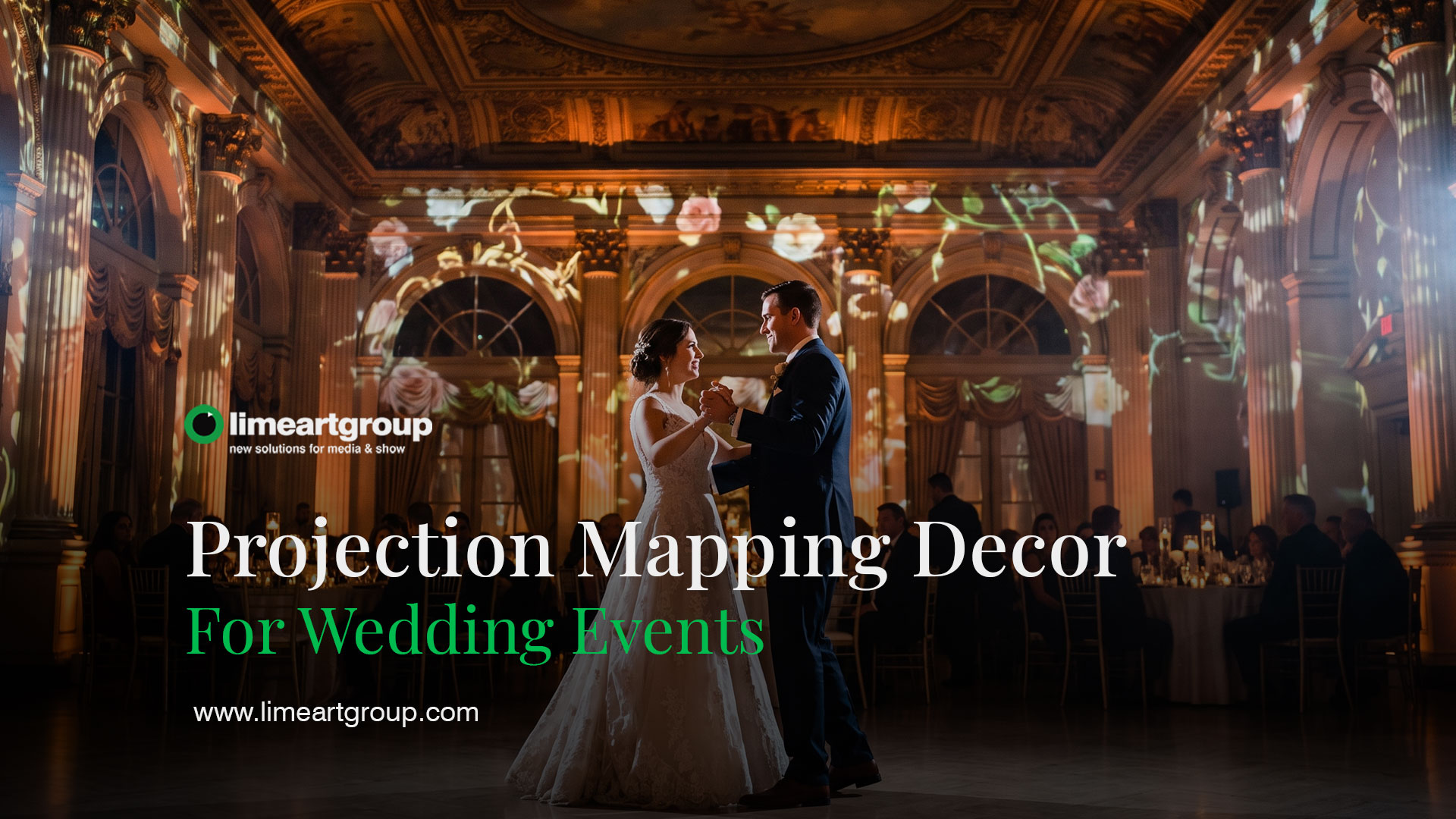
Wedding Projection Mapping in 2026: What It Costs and When to Use It
The article is written by a human. Mistakes have been edited by AI.
Wedding cost data from The Knot 2026 Real Weddings Study and UK industry reporting. Rental rates from published 2026 vendor pricing. Checked August 2026.
The 2019 version of this article said projection mapping was “immediate and affordable” and left it there. That was not useful then and it is not useful now, because the same two words cover a €900 cake projection and a €60,000 room transformation.
So this version starts with numbers a couple is actually working with, and only then talks about what projection can do.
Who this article is for: couples planning a wedding, and the planners, venues and event agencies quoting for one.
What it solves: every guide describes what projection mapping can do and none of them says what it costs against the budget you are actually holding, or how much content a wedding day really consumes.
What you get by the end: real 2026 rental prices next to real wedding budget categories, a cue sheet for the whole day, the venue constraints that decide everything, and a content plan you can buy against.
Hello dear couples, planners and clients of LIME ART GROUP. I am new media artist Alexander Kuiava. We produce the content used at events like these and we run the Video Mapping Store together with our partners, so the practical sections come from jobs rather than from brochures.
What a wedding costs in 2026, and where projection fits
The Knot’s 2026 Real Weddings Study surveyed 10,474 US couples married during 2025. The findings:
- Average total cost: $34,200
- Average guest count: 117
- Average cost per guest: $292
In the UK the 2026 average sits around £21,990. Destination weddings run roughly 20 percent above domestic on average, with all-inclusive packages far below that and full-vendor destination events well above.
The Knot’s category guidance splits a typical budget approximately as follows: venue and catering 45 percent, photography 12 percent, attire 9 percent, flowers 8 percent, music 7 percent, rings 4 percent, stationery 3 percent, transport 2 percent, favours 2 percent, contingency 8 percent.
Now put projection next to the categories a couple already accepts as normal.
| Item | Typical 2026 spend | What you get |
|---|---|---|
| Wedding flowers | around $2,200 national average, $1,000 to $10,000+ | physical décor, discarded the next morning |
| DJ or entertainment | roughly $1,000 to $3,000 | 3 to 5 percent of budget |
| Photography | around 12 percent of budget | the record of the day |
| Single-projector setup with one AV technician | from about $1,000 per day | cake mapping, an accent wall, or one focal surface |
| Two-projector setup with one technician | from about $1,300 per day | brighter coverage, wider surface |
| Larger multi-projector rig with two technicians | around $3,500 per day | gala-scale coverage |
| Full venue projection mapping | $15,000 to $50,000 per event | the whole room transformed |
Two things fall out of that table immediately.
First: the entry point is cheaper than the flowers. A single-projector setup with a technician costs less per day than the average American couple spends on floral arrangements, and it does something flowers cannot — it changes between the ceremony, the dinner and the party without anyone touching it.
Second: “projection mapping” is not one product. A full-venue transformation costs more than the entire average wedding. When a couple asks three vendors for a price and gets $1,200, $9,000 and $48,000, nobody is lying. They are quoting three different things. The fix is to name the surface before you ask the price.
Two practical notes on rentals that catch people out. Most rental companies impose a minimum booking of two to three days even for a one-day wedding, because of load-in and load-out. And technician time is usually billed separately at roughly $50 to $200 per person per day plus travel and accommodation, which matters a great deal at a destination wedding.

Wedding Visuals
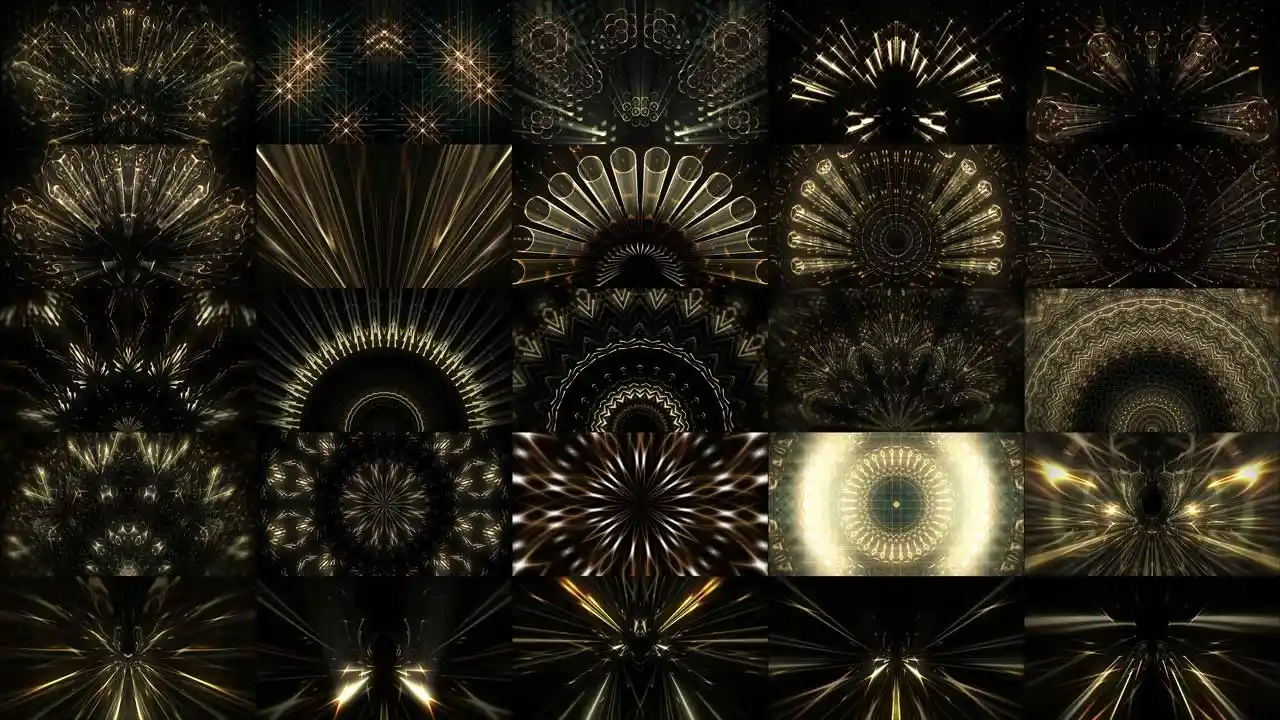
Ambient, ornamental and cake mapping content for the whole evening
-
Video Mapping Loops Pack Vol.8 – Gold Edition
129€ -
Sale!
Video Mapping Toolkit Vol.5 – Light Ray
Original price was: 149€.99€Current price is: 99€. -
VJ Loops Pack Vol.28 – DecoLines
99€ -
Sale!
Video Mapping Toolkit Vol.14 – Flower Boom
Original price was: 149€.99€Current price is: 99€. -
Sale!
Wedding Cake – Video Mapping Event Visuals Vol.1
Original price was: 249€.149€Current price is: 149€. -
Sale!
Video Mapping Toolkit Vol.19 – Rose House
Original price was: 129€.59€Current price is: 59€. -
Sale!
Pink Love – Video Mapping Wedding Cake Visuals Vol.2
Original price was: 249€.149€Current price is: 149€. -
VJ Loops Pack Vol.52 – Elika
89€ -
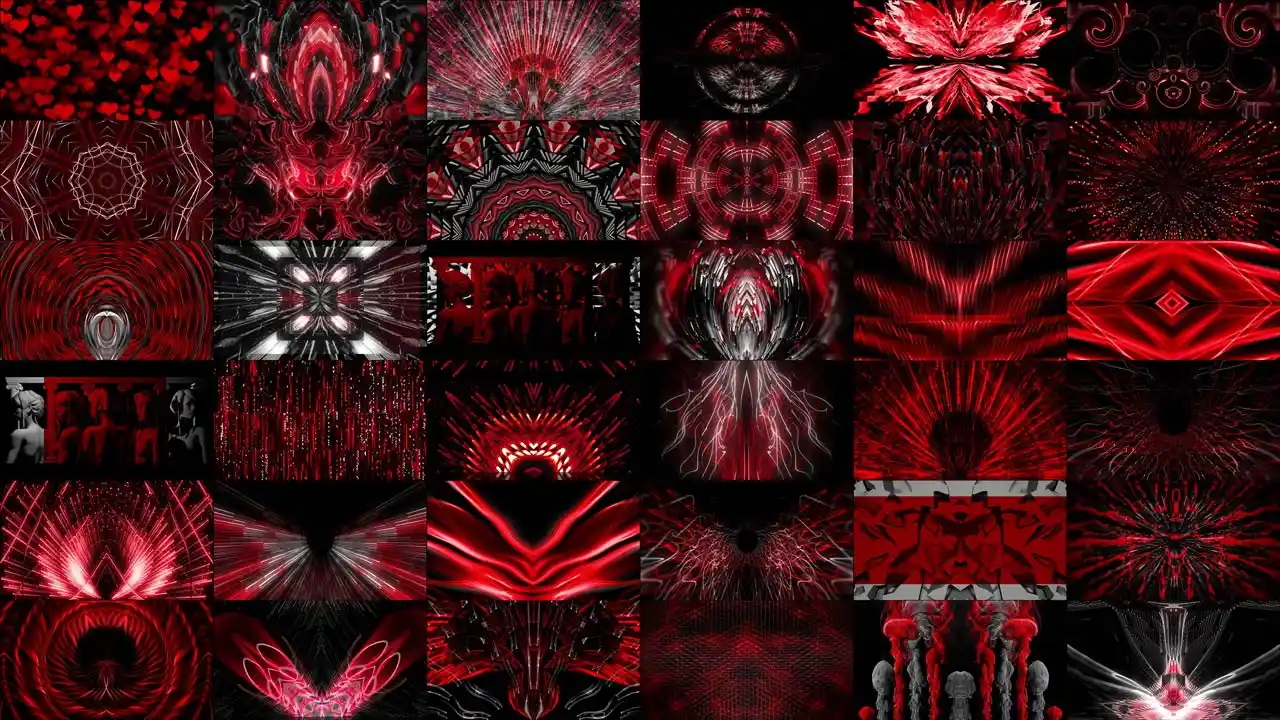
VJ Loops Pack Vol.19 – Lovely Red
79€









The wedding day is a cue sheet, not a show
This is the part almost every guide skips, and it is where budgets go wrong.
A wedding runs six to ten hours. Within that there are perhaps five moments where a visual actually changes what people feel, and a great deal of time where the visual has to be present without demanding attention. Treating the whole day as one “show” leads to either far too little content or far too much money spent in the wrong place.
Here is the day broken into its real segments.
| Moment | Typical duration | What the visual must do | Content needed |
|---|---|---|---|
| Guest arrival, cocktails | 60 to 90 minutes | ambient, low contrast, never competing with conversation | 3 to 6 slow loops |
| Ceremony | 20 to 40 minutes | almost nothing — static or extremely slow, or no projection at all | 1 to 2 loops |
| Dinner | 90 to 150 minutes | atmosphere that shifts slowly; no strobing over food | 6 to 10 loops |
| Cake cutting | 3 to 5 minutes | carry the most photographed moment of the evening | 1 mapped sequence |
| First dance | 3 to 5 minutes | the one genuine set piece | 1 designed sequence |
| Party | 2 to 4 hours | energy and tempo; this is where you can be bold | 20 to 40 clips |
Add it up and a full wedding needs roughly 30 to 60 usable loops plus two designed sequences. That is one or two coherent packs and a cake set — not a bespoke commission, and not six clips on repeat.
The specific mistake: couples and planners budget attention and money for the first dance, then discover the party is four hours long. Six clips looped across four hours is visible to everyone in the room by the second hour, and it is the single most common failure in wedding projection.
The second most common is contrast. Content designed for a nightclub, played during dinner, makes food look wrong and makes people squint. Dinner content should be slow, low in contrast, and warm. Save the saturation for after the cake.
What the venue decides before you do
You can choose the content. You cannot choose most of these.
Ambient light is the whole argument
Projection is additive light. It cannot make anything darker. A useful field test: if guests can read a menu comfortably without leaning in, projection will look washed out.
That rules out most daylight ceremonies, most marquees before sunset, and any room with uncovered windows facing the projection surface. It is also why a summer wedding at 19:00 and the same wedding at 22:00 are different technical projects. If the ceremony is in daylight, put the projection budget into the evening instead of fighting the sun.
Surface
White or light-coloured matte surfaces are ideal. Drape works extremely well, which is why draping and projection have become a standard pairing — the drape gives you a clean, controllable canvas over whatever the venue actually looks like. Textured stone absorbs light and swallows fine detail. Anything glossy, mirrored or varnished is unusable, because it reflects the beam rather than diffusing it.
Rigging, sightlines and shadows
Historic venues and listed buildings frequently prohibit rigging to ceilings or walls. That pushes you to freestanding towers, which take floor space and have to be positioned where guests will not walk through the beam — because anybody between the projector and the surface becomes a silhouette on it. Short-throw lenses and rear projection solve this where the room geometry allows.
The load-in window
Most wedding venues give a supplier a few hours, often shared with the florist, the caterer and the band. Cake mapping alone needs roughly 30 to 60 minutes of on-site calibration once the cake is physically in position — and the cake usually arrives late, because cakes always arrive late. Build that into the schedule or accept that the alignment will be approximate.
Noise and power
Projectors have fans. A bright projector has loud fans. Do not place one behind or beside a ceremony where vows are being spoken. Check available power circuits with the venue rather than assuming, and ask about permits and insurance for anything mounted on a historic exterior.
The questions to ask the venue
- Can we rig, or must everything be freestanding?
- What time can we access the room, and who else is in it?
- Can the room be darkened, and how — blackout, blinds, or nothing?
- Where are the power circuits and what is available on each?
- What is the ceiling height and are there beams, chandeliers or fans in the way?
- Is there a noise or curfew restriction, and does it apply to equipment?
The thing that actually goes wrong
It is almost never the technology. It is the timeline.
The pattern repeats: content is approved two weeks out. Then the venue changes the table plan, so the projector position no longer works. The cake turns out to be four tiers instead of five, and a different diameter than the photograph. The florist puts a tall arrangement exactly where the beam runs. Nobody has an hour of dead time before guests arrive, so calibration happens with the first arrivals already in the room.
None of that is a projection problem. All of it is a scheduling problem that projection exposes.
Three fixes, and they cost nothing. Get the cake dimensions in writing from the baker — tier count, diameters and heights — and give them to whoever prepares the content. Get the final floor plan from the venue and mark the projector positions and beam paths on it, then send it to the florist. And protect one hour of empty room before guests arrive. That hour is the difference between a clean show and a visible compromise.
The six formats, and which one you actually want
Briefly, in order of how easy they are to achieve:
- Cake mapping — one projector, one laptop, one moment. The entry point, and the highest photographed-return per euro spent of anything in this list.
- Dress projection — a short, choreographed sequence onto the gown during the entrance. Spectacular, and unforgiving of movement.
- Wall and panoramic projection — the reception space wrapped in a continuous environment that changes across the evening.
- Object and arch mapping — a single scenic structure behind the couple that transforms at one designated moment. The most dramatic single beat available.
- Full immersive venue — floors, walls and ceiling together. This is a venue capability rather than a wedding purchase; permanently equipped rooms exist and are booked as such.
- Outdoor architectural projection — the facade of a château, manor or hotel during cocktails or after dinner. The largest scale, and the most dependent on darkness and permissions.
Our partner project Video Mapping Store has published a format-by-format guide covering the technical setup, content requirements and real use cases for each of these, including the equipment cost breakdown. If you have decided that you want projection and now need to decide which kind, start there — it goes deeper on the formats than this article does, and it carries the largest wedding mapping content library we know of, including dedicated cake collections, the Golden Age and Flower Boom toolkits for architectural surfaces, and wedding bundles built for event agencies.
Building the content plan
Work backwards from the cue sheet above. You need three kinds of material, and they are not interchangeable.
Green Screen Performers
Keyed dancers and performers to composite into a projected environment
-
Video Mapping Loops Pack Vol.8 – Gold Edition
129€ -
Sale!
Video Mapping Toolkit Vol.5 – Light Ray
Original price was: 149€.99€Current price is: 99€. -
VJ Loops Pack Vol.28 – DecoLines
99€ -
Sale!
Video Mapping Toolkit Vol.14 – Flower Boom
Original price was: 149€.99€Current price is: 99€. -
Sale!
Wedding Cake – Video Mapping Event Visuals Vol.1
Original price was: 249€.149€Current price is: 149€. -
Sale!
Video Mapping Toolkit Vol.19 – Rose House
Original price was: 129€.59€Current price is: 59€. -
Sale!
Pink Love – Video Mapping Wedding Cake Visuals Vol.2
Original price was: 249€.149€Current price is: 149€. -
VJ Loops Pack Vol.52 – Elika
89€ -
VJ Loops Pack Vol.19 – Lovely Red
79€
Ambient material for cocktails and dinner
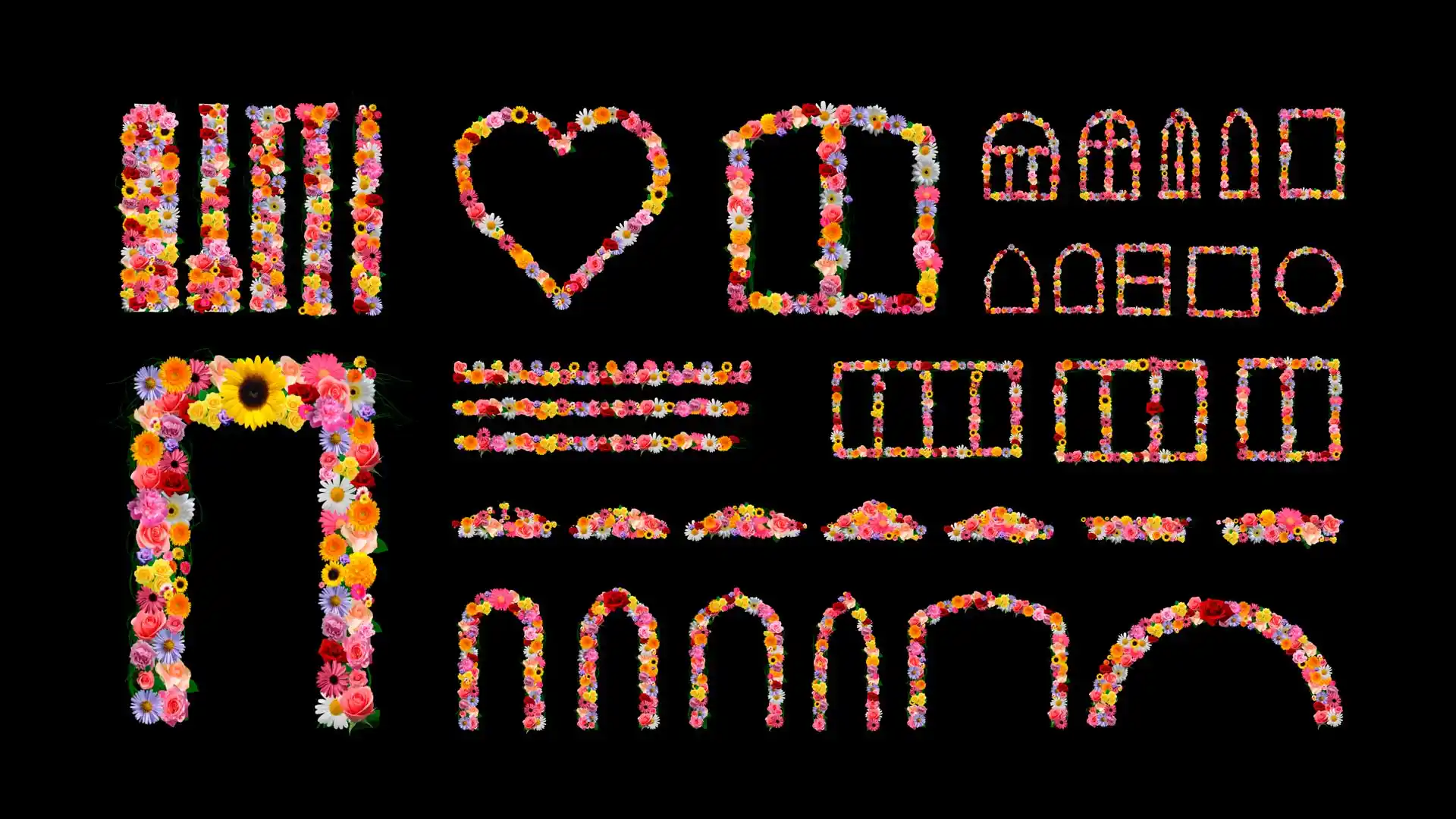
Slow, warm, low-contrast, botanical or ornamental. It has to survive being looked at for two hours without becoming irritating. From our wedding visuals category, the packs that do this job are the floral and botanical ones — Flowers Flow, Saint Zantedeschia, Butterfly Effect 4K and Elika — and the ornamental sets DecoLines, Vintage Screens, Art Glint and Shiny Patterns, which sit particularly well on drape and on wall panels. These run between 79€ and 129€ per pack, and one or two of them cover the entire first half of the evening.
Surface material for walls, arches and architecture
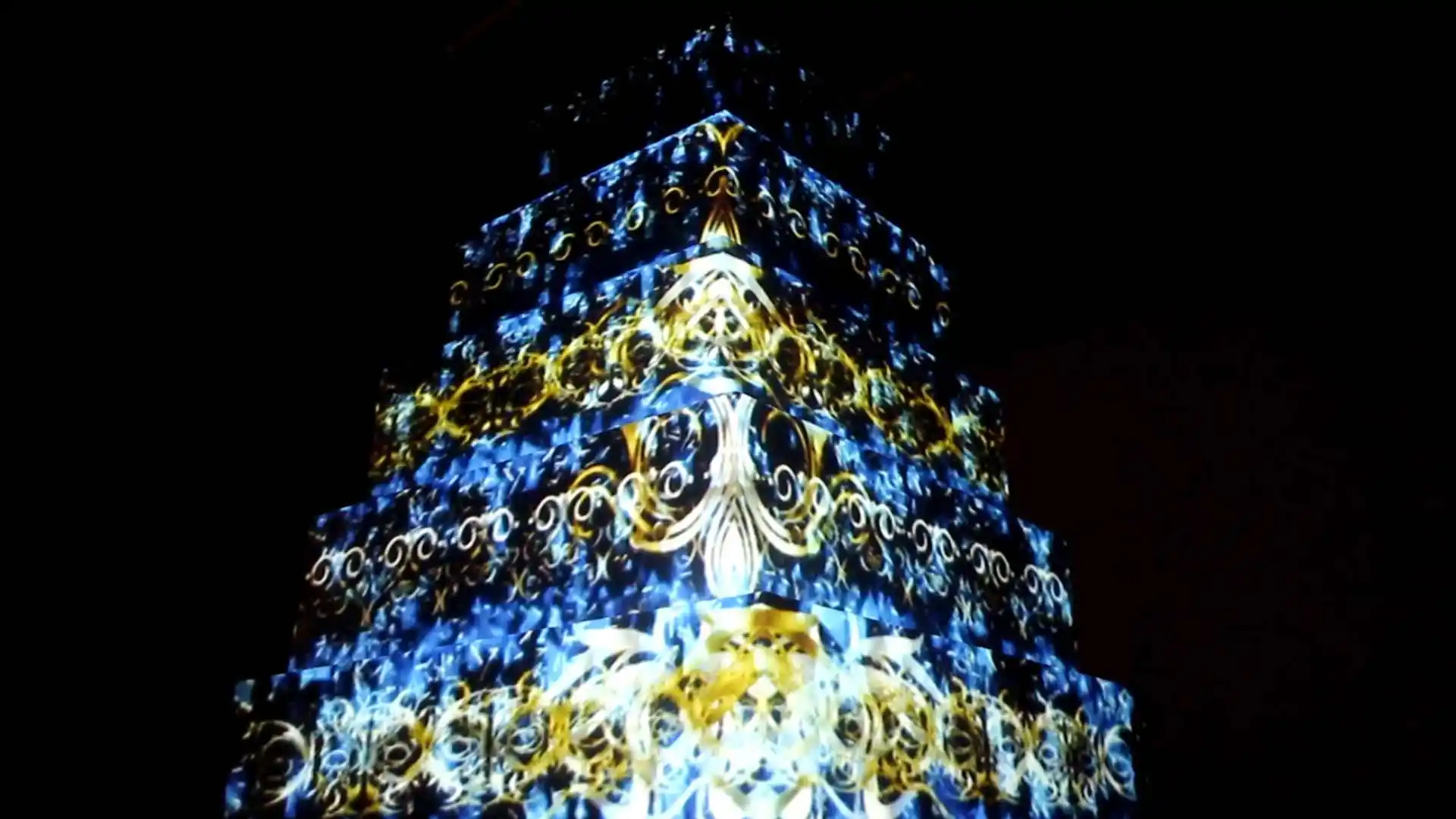
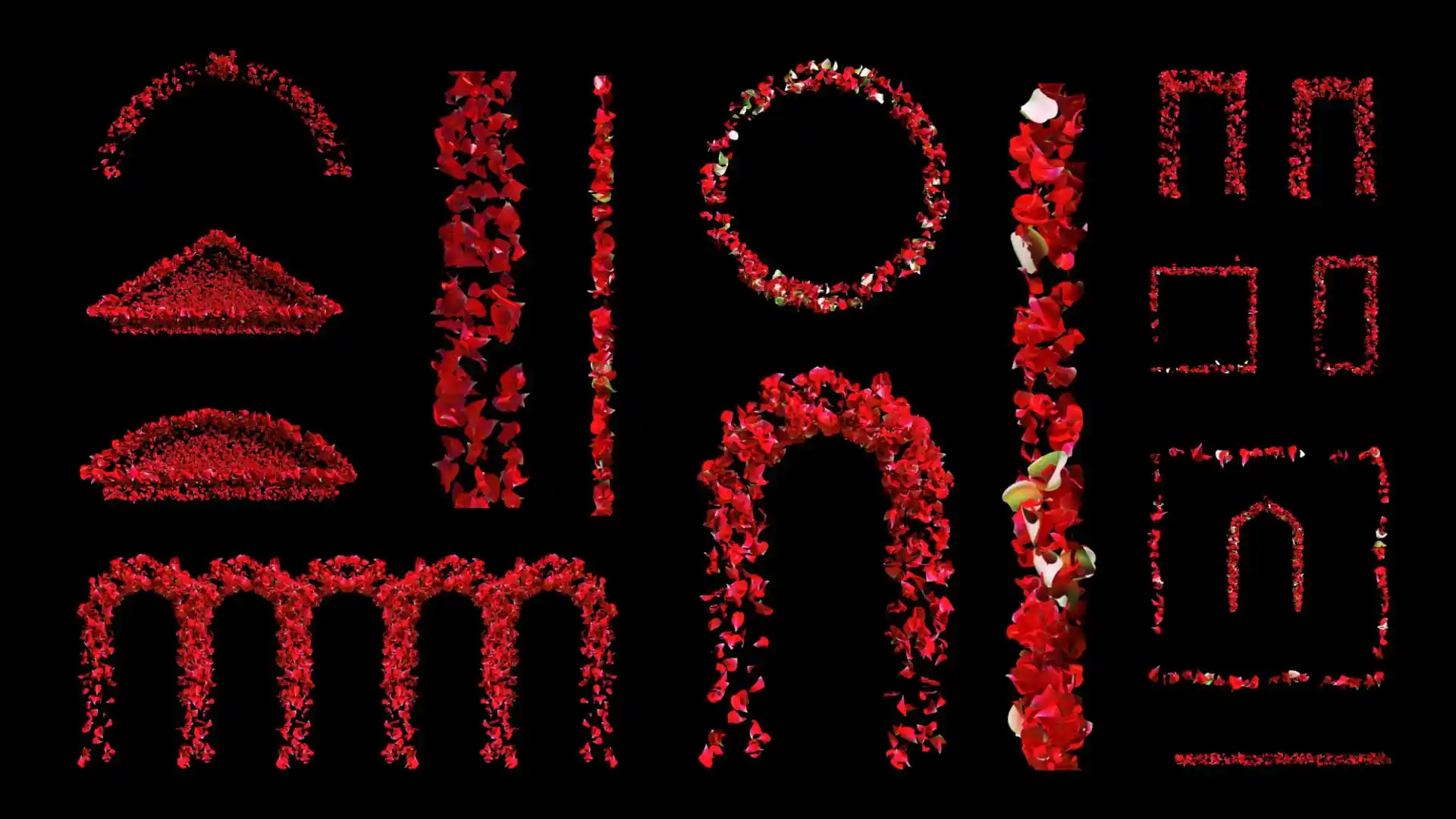
Content built as architectural elements rather than as films — masks, ornament, growth animations, light rays. Video Mapping Loops Pack Vol.8 Gold Edition at 129€, and the toolkits Rose House Vol.19, Flower Boom Vol.14 and Light Ray Vol.5, currently 59€ to 99€. Toolkits differ from loop packs in that they give you separable elements to compose against a specific surface, which is what mapping actually requires. The wider video mapping toolkits and video mapping loops categories carry the rest.
The cake
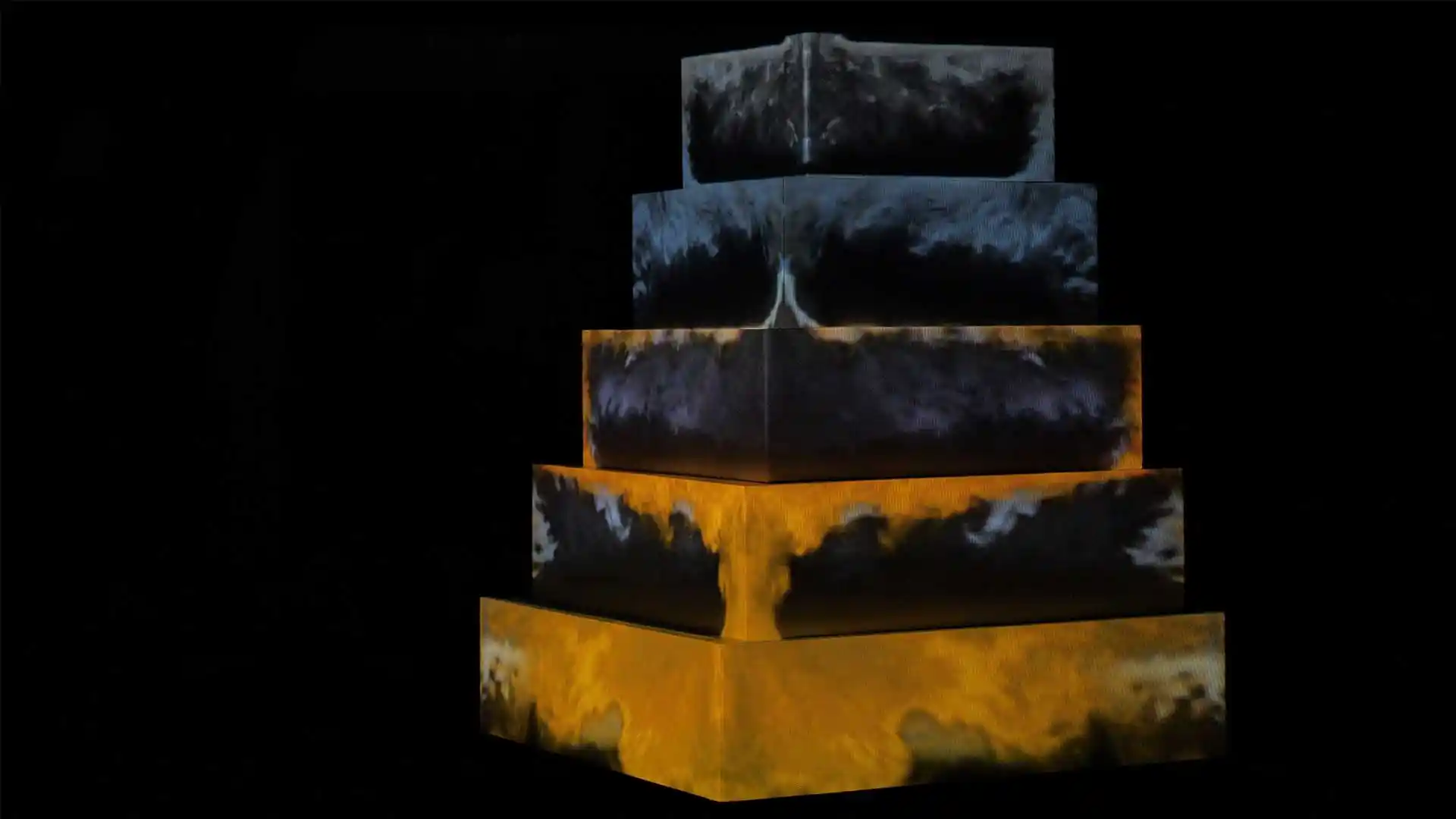
Wedding Cake — Video Mapping Event Visuals Vol.1 and Pink Love Vol.2, both currently 149€ from 249€. Both are built around five-tier geometry, which is deliberate: fewer tiers means you leave the unused layers unmapped, more tiers means you duplicate one during calibration. It scales down more gracefully than it scales up, so if in doubt design for more tiers than you have.
The one line nobody else sells for weddings
This is worth a paragraph of its own, because it is genuinely unusual and most people planning a wedding do not know it exists.
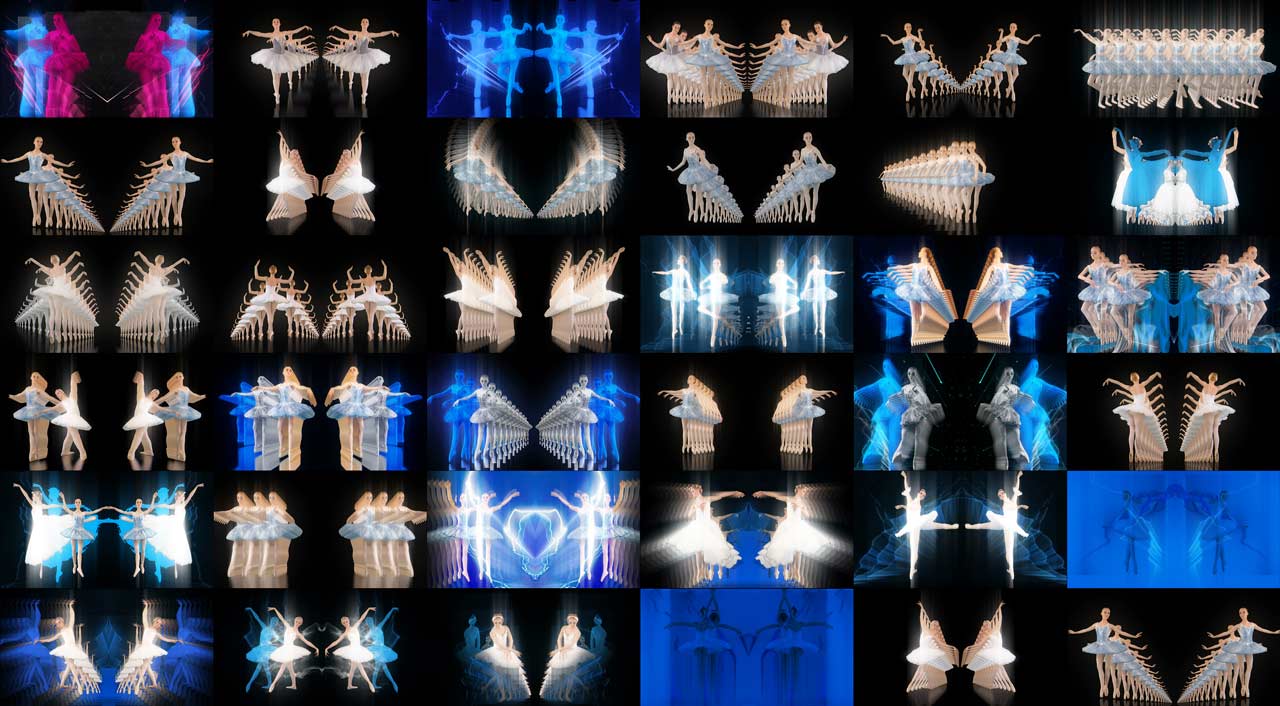
Our green screen footage library includes keyed performers shot specifically for events: Viennese Waltz, Ballet Dance, Ballerina, Rumba Dance, Graceful Dance, Wedding Performer and folk dance collections, from 59€. Because they are chroma-keyed, you can composite a waltzing couple onto a projected ballroom wall, place a ballerina inside a floral environment on an LED panel, or drop performers into a save-the-date film or the entrance video.
That is a different creative move from projecting a texture onto a surface. It puts figures inside the environment rather than pattern on top of it, and at a wedding — an event that is fundamentally about people — that reads very differently. It is also the cheapest way to make a projected room feel inhabited rather than decorated.
A practical checklist
- Name the surface before you ask for a price. Cake, one wall, the whole room and the building facade are four different projects with an order of magnitude between them.
- Check the light before anything else. If guests can comfortably read a menu, projection will disappoint. Move it later in the evening rather than fighting daylight.
- Budget the party, not just the first dance. Four hours needs 20 to 40 clips. Six on repeat is visible by the second hour.
- Get cake dimensions in writing — tier count, diameters, heights — and pass them to whoever prepares the content.
- Mark beam paths on the final floor plan and send it to the florist and the venue, so nothing tall lands in the projection path.
- Protect one hour of empty room before guests arrive. It is free and it is the difference between clean and approximate.
- Ask about rigging, blackout, power and curfew at the site visit, not at load-in.
- Buy content by function, not by mood board. Ambient for dinner, elements for surfaces, one sequence for the cake, energy for the party.
Frequently asked questions about wedding projection mapping
How much does wedding projection mapping cost in 2026?
It depends entirely on the surface. A single-projector setup with one AV technician starts from around $1,000 per day and covers a cake, an accent wall or one focal surface. Two projectors with a technician start around $1,300 per day. A larger rig with two technicians runs around $3,500 per day. Full venue projection mapping across a whole room typically costs $15,000 to $50,000 per event. Most rental companies also require a two to three day minimum booking, and technician time is usually billed separately.
Is projection mapping cheaper than wedding flowers?
At the entry level, yes. The 2026 national average for wedding flowers is around $2,200, with a common range of $1,000 to $10,000 and above. A single-projector setup with a technician starts near $1,000 per day. Unlike flowers, the same equipment can carry the ceremony, the dinner and the party with completely different looks. A full-venue projection transformation, on the other hand, costs more than the entire average wedding.
How much content does a wedding actually need?
Around 30 to 60 usable loops plus two designed sequences. Cocktails and arrival need 3 to 6 slow loops, dinner 6 to 10, the party 20 to 40, plus one mapped sequence for the cake and one for the first dance. The most common mistake is budgeting for the first dance and forgetting that the party runs two to four hours, which is where most of the content is actually consumed.
Can you do projection mapping in daylight?
Effectively no. Projection adds light, it cannot remove it, so a bright room washes out the image regardless of projector brightness within any sane budget. A practical test is whether guests can read a menu comfortably without leaning in; if they can, projection will underwhelm. For daylight ceremonies the sensible move is to shift the projection budget to the evening portion of the day.
What do I need for wedding cake projection mapping?
A projector of roughly 3,000 lumens or more positioned at a controlled distance, a laptop running mapping software such as MadMapper, Resolume Arena or HeavyM, content built for tiered cake geometry, a dimmed room, and 30 to 60 minutes of calibration once the cake is physically in place. Get the tier count, diameters and heights from the baker in writing beforehand, because content designed for the wrong geometry cannot be fixed on the night.
Will projection mapping work in a historic venue?
Often, but with constraints. Listed and historic venues frequently prohibit rigging to walls and ceilings, which forces freestanding towers that occupy floor space and need clear beam paths away from guest circulation. Stone and textured surfaces absorb light and lose fine detail. Exterior projection may require additional permissions and insurance. Ask about rigging, access times, power and curfew at the site visit rather than at load-in.
What is the difference between a VJ loops pack and a video mapping toolkit?
A loops pack is finished full-frame content designed to be played as-is, which suits walls, drape and screens. A toolkit provides separable elements — ornaments, masks, growth animations, light effects, usually with alpha channels — that you compose against the specific geometry of the surface you are mapping. For a cake, an arch or a facade you want a toolkit. For dinner atmosphere on a draped wall you want a loops pack.
Can we use projection instead of a photo slideshow?
Yes, and it usually works better. A slideshow occupies one screen and asks everyone to look at it at once. Projection can distribute imagery across the walls of a room so it becomes part of the environment rather than an interruption. Keyed footage of performers on green screen can be composited into those environments as well, which makes a projected room feel inhabited rather than merely decorated.
Sources
The Knot 2026 Real Weddings Study — average US wedding cost of $34,200, average guest count of 117, average cost per guest of $292, based on 10,474 US couples married between 1 January and 31 December 2025.
The Knot budget guidance — category allocation of approximately 45 percent venue and catering, 12 percent photography, 9 percent attire, 8 percent flowers, 7 percent music, with contingency.
Wedding industry reporting, 2026 — national average for wedding flowers of approximately $2,200 with a typical range of $1,000 to $10,000 and above; DJ and entertainment at roughly 3 to 5 percent of budget, or approximately $1,000 to $3,000.
UK wedding industry reporting, 2026 — average UK wedding cost of approximately £21,990.
Destination wedding reporting, 2026 — destination weddings averaging approximately 20 percent above domestic cost.
Published 2026 AV rental pricing — single projector with one technician from approximately $1,000 per day, two-projector setup from approximately $1,300 per day, larger rigs with two technicians at approximately $3,500 per day, minimum bookings of two to three days, technician time at approximately $50 to $200 per person per day plus travel and accommodation.
Projection mapping industry pricing guides, 2026 — full event projection mapping in the range of $15,000 to $50,000, with equipment-only cost split of roughly 35 to 50 percent projectors, 10 to 20 percent media server, 5 to 15 percent mounting and rigging, 15 to 40 percent content and 15 to 25 percent labour.
Video Mapping Store — Projection Mapping for Weddings guide, published May 2026, covering cake, dress, interior, immersive venue and outdoor architectural formats with technical setup and content recommendations.
LIME ART GROUP product catalogue — wedding category pricing as listed at time of writing.
What to do next
If you are a couple: decide the surface and the moment first, then get quotes. A single focal surface at the right moment beats a washed-out room at the wrong one, and it costs a fraction as much.
If you are a planner or an event agency: the content library is the reusable asset. Equipment is rented per event, but a wedding toolkit and a set of ambient packs are bought once and used across every wedding you produce for years. That is where the margin is.
If you already know which format you want and need the technical detail and the content for it, our partner project Video Mapping Store covers the formats in depth and holds the wedding mapping collections. If you need the ambient, ornamental and performer content that fills the rest of the evening, that is what the categories below are for.
Latest Feature Visuals
Hand-picked visuals by our New Media Artists
-
Sale!
VJ Loops Pack Vol.73 – Mirror Ballet
Original price was: 129€.99€Current price is: 99€. -
VJ Loops Pack Vol.18 – Abstract Background Textures
89€ -
VJ Loops Pack Vol.19 – Lovely Red
79€ -
VJ Loops Pack Vol.11 – Really Madonna
89€ -
VJ Loops Pack Vol.85 – Gnosis Lightning
99€ -
VJ Visuals Starter Pack
99€ -
Sale!
Pink Love – Video Mapping Wedding Cake Visuals Vol.2
Original price was: 249€.149€Current price is: 149€. -
VJ Loops Pack Vol.83 – Vivid Wheat
99€ -
Sale!
Green Screen Video Footage Bundle Vol.1 – 5in1
Original price was: 499€.299€Current price is: 299€.







Best wishes from Vienna,
Thanks for your attention, faithfully yours,
Alexander Kuiava – Founder & CEO LIME ART GROUP
https://alexanderkuiava.com/
