
What Resolution Do VJs Actually Use — 2026 Data and a Ten-Year Forecast
The article is written by a human. Mistakes have been edited by AI. Poll data from our own surveys, July 2022 and July 2026. Market figures checked July 2026.
In July 2022 I asked 567 VJs which resolution they mostly use. Sixty-five per cent said Full HD 1920×1080. Two per cent said 8K. I re-ran the poll on 30 July 2026 across our Telegram channel and our Facebook community. Full HD lost its majority. It now sits somewhere between 34% and 41% depending on which platform you ask, and the 4K family has overtaken it. That is a larger move than I expected. Consequently this article now carries both data sets, the four-year comparison, and an honest account of where the two polls disagree — because they disagree in a way that is more interesting than either number on its own.
Who this article is for: VJs and motion designers deciding what to render, content producers deciding what to stock, and technical directors specifying a show.
What it solves: everyone assumes resolution goes up over time. In this industry it does not go up uniformly — it splits, and the split is the whole story.
What you get by the end: both polls side by side, the arithmetic that tells you what resolution a screen can actually display, why architectural mapping and immersive interiors are moving in opposite directions, how geography changes the answer, and a forecast to 2036 with reasoning you can check.
Hello dear VJs and clients of LIME ART GROUP. I am new media artist Alexander Kuiava. I run these polls periodically because our own production planning depends on the answer — what we render, we have to sell.
The poll: 567 votes, July 2022
| Resolution | Share |
|---|---|
| Full HD 1920×1080 | 65% |
| UltraHD 3840×2160 | 19% |
| 4K 4096×2304 | 6% |
| Ultrawide HD 5760×1080 | 4% |
| 8K 7680×4320 | 2% |
| HD 1280×720 | 1% |
| Everything else | ~3% |
Two things stand out. Full HD had two thirds of the market, and the entire 4K family — UltraHD plus true 4K — took only about a quarter between them. 8K was a rounding error.
The second thing is the 1% for 720p, which a respondent added to the poll himself. That option was not on my list because I assumed nobody still used it. Somebody did, and it is a useful reminder that this industry is global and the tail is long.
Everything below the poll is reasoning from market data and from what we actually sell, and I will say clearly which is which.


The 2026 poll: what four years actually did
I ran the same question again on 30 July 2026, in two places at once.
Telegram, 82 voters
Our Telegram channel allows multiple answers, so 82 people cast 113 votes — an average of 1.38 formats each. That is itself a finding: most working VJs do not have a resolution, they have two or three depending on the job.
| Resolution | Votes | Share of votes |
|---|---|---|
| Full HD 1920×1080 | 38 | 34% |
| 4K 4096×2304 | 25 | 22% |
| UltraHD 3840×2160 | 16 | 14% |
| 8K 7680×4320 | 15 | 13% |
| Ultrawide HD 5760×1080 | 11 | 10% |
| HD 1280×720 | 8 | 7% |
Facebook community, same day
| Resolution | Share |
|---|---|
| Full HD 1920×1080 | 41% |
| UltraHD 3840×2160 | 38% |
| 4K 4096×2304 | 7% |
| HD 1280×720 | 5% |
| Ultrawide HD 5760×1080 | 4% |
| 8K 7680×4320 | 4% |
| PAL (added by a respondent) | 1% |
| 2K 2560×1440 (added by a respondent) | 0% |
Somebody added PAL as an option and it got 1%. Four years ago somebody added 720p and it got 1%. Consequently I have stopped being surprised by this.
The four-year comparison
| Format | 2022 | Telegram 2026 | Facebook 2026 | Mean 2026 | Change |
|---|---|---|---|---|---|
| Full HD 1920×1080 | 65% | 34% | 41% | ~38% | −27 pts |
| UltraHD 3840×2160 | 19% | 14% | 38% | ~26% | +7 pts |
| 4K 4096×2304 | 6% | 22% | 7% | ~15% | +9 pts |
| 8K 7680×4320 | 2% | 13% | 4% | ~9% | +7 pts |
| Ultrawide HD 5760×1080 | 4% | 10% | 4% | ~7% | +3 pts |
| HD 1280×720 | 1% | 7% | 5% | ~6% | +5 pts |
The headline is unambiguous. Full HD went from a two-thirds majority to roughly a third in four years. Moreover, group everything at 1080 and below against everything above it, and the bloc that was 66/31 in 2022 is now roughly 44/56. It has flipped.
Where the two polls disagree, and why that matters
Look at UltraHD 3840×2160 against 4K 4096×2304. Facebook says 38% and 7%. Telegram says 14% and 22%. Those are not small differences; they are inverted.
The explanation is almost certainly the labels, rather than the hardware. Very few working VJs distinguish reliably between UHD at 3840 and DCI 4K at 4096, so most people read whichever line looks like “4K” and pick it. However, combine the two rows and the platforms stop arguing:
| 2022 | Telegram | ||
|---|---|---|---|
| 4K family (UHD + DCI) | 25% | 36% | 45% |
| Full HD | 65% | 34% | 41% |
On both platforms the 4K family is now at or above Full HD. That is the real result, and it survives the labelling problem that breaks the individual rows.
Therefore the practical lesson for anyone running a poll like this: do not offer 3840 and 4096 as separate options unless your audience is technical directors. You will get noise.
Three honest caveats
The sample got smaller, not bigger. 567 votes in 2022 against 82 on Telegram plus an unpublished number on Facebook. Consequently the 2026 figures are directional rather than precise, and I would not defend any single percentage point.
The Telegram poll was multi-select and the 2022 poll was not. That inflates the smaller formats, because somebody who mostly works in Full HD but has done one 8K job can tick both. Indeed it is the most likely reason Telegram shows 13% for 8K while Facebook shows 4%.
I cannot weight the two samples together, since Facebook publishes percentages without vote counts. The “mean” column above is a simple unweighted average of two differently sized polls, and it is there to give a rough centre of gravity rather than a measurement.
What survives all three caveats is the direction and its size: Full HD is no longer the default, and the 4K family is.

What changed between 2022 and 2026
Three things moved, and none of them moved the way the “resolution always increases” assumption predicts.
8K stopped being a future and became a discontinued product
This is the clearest signal in the whole industry and it has a date on it. LG Display ceased production of all 8K TV panels at the end of January 2026, leaving Samsung as the only major manufacturer still developing 8K television. Consumer interest plateaued in 2023 and never recovered. Estimated 8K penetration is 2–5% of television households in 2026.
The reasons are the same ones VJs already knew: there is almost no native 8K content, production costs are high, and 8K streaming needs upwards of 100 Mbps. 4K remains the practical premium tier, and it is going to stay there.
For our industry this matters because consumer display economics drive panel and chip production, which drives what ends up in projectors and LED processors. 8K is not going to arrive in live events on the back of consumer demand, because there is no consumer demand. It will arrive, where it arrives at all, through very large LED walls and immersive rooms — which is a different mechanism and a much narrower one.
LED got finer, and that changed the question
Meanwhile the LED side moved fast. Chip-on-board packaging is pushing pixel pitches below 0.9 mm. P1.5 and P1.9 are now routine requests on trade show floors where P3.9 was standard a few years ago. Analysts expect fine pitch to take over 35% of the professional display market in 2026, and the small pixel pitch segment alone is modelled to grow from about $3.1 billion in 2024 to over $10 billion by 2033.
This is the real driver of higher-resolution content demand, and it has nothing to do with 8K televisions. A finer pitch on the same physical wall means more pixels on that wall, which means the content has to have them.
AI made high-resolution content cheap to generate and expensive to finish
Generative tools removed the cost of producing a high-resolution frame. They did not remove the cost of upscaling, encoding, storing and playing back a two-hour set of them. The bottleneck moved from the render farm to the drive and the GPU, which is exactly where VJs feel it — and it is one reason Full HD has held on.
VJ Loops Packs
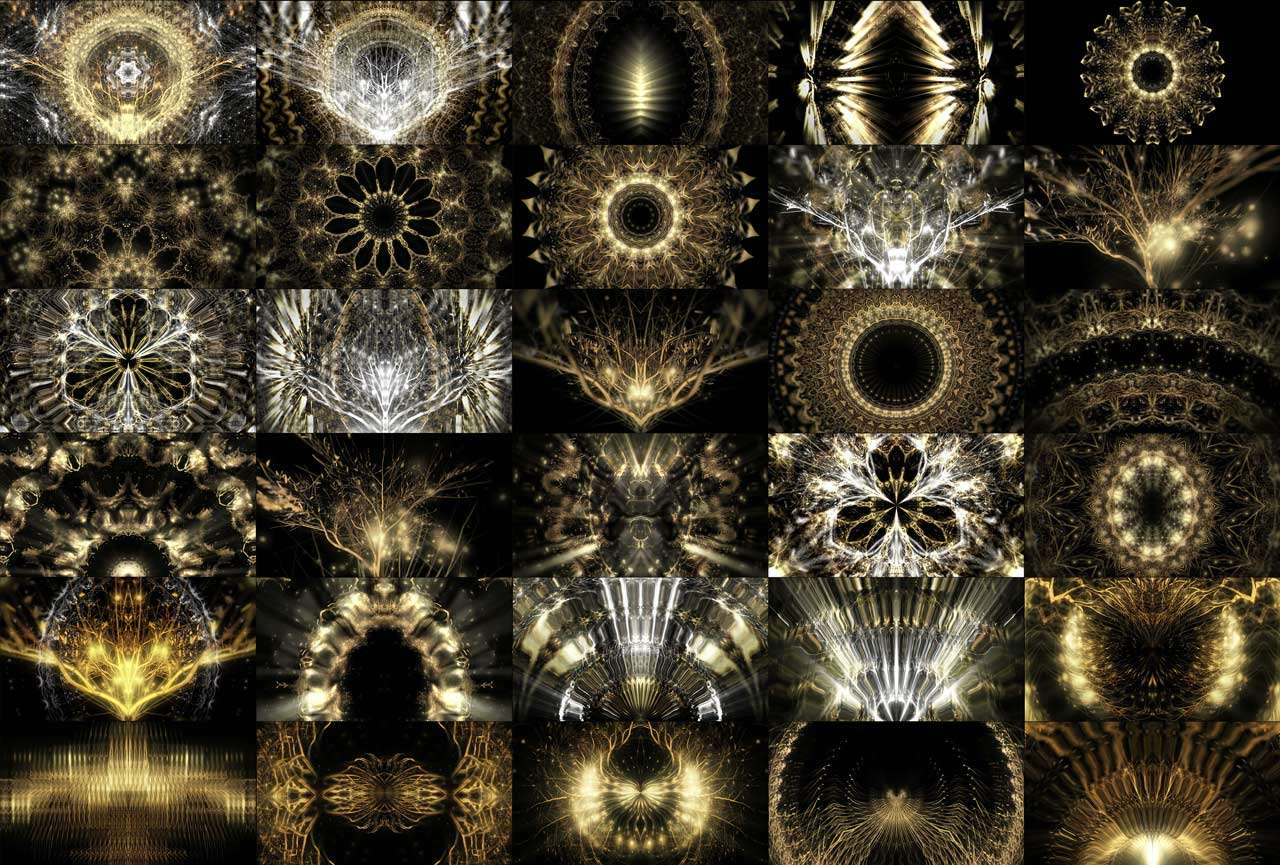
Supplied in Full HD and 4K, plus ultrawide and non-standard formats
-
VJ Loops Pack Vol.41 – Goldfrau
79€ -
VJ Loops Pack Vol.29 – Glitch Backgrounds
89€ -
VJ Loops Pack Vol.17 – Main Element
99€ -
VJ Loops Pack Vol.28 – DecoLines
99€ -
VJ Loops Pack Vol.18 – Abstract Background Textures
89€ -
VJ Loops Pack Vol.11 – Really Madonna
89€ -
VJ Loops Pack Vol.12 – Interstellar Hypergate
59€ -
VJ Loops Pack Vol.1 – Smart Lines
99€ -
Vj Loops Pack Vol.26 – Gilded Roots
99€









Resolution is decided by the surface, not by the year
This is the core of the article. The correct resolution is not a trend. It is arithmetic.
The LED calculation almost nobody does
An LED wall’s real resolution is its physical width divided by its pixel pitch. That is the whole formula, and it produces some uncomfortable numbers.
| Wall width | P3.9 | P2.6 | P1.9 | P1.5 | P1.2 |
|---|---|---|---|---|---|
| 4 m | 1,026 px | 1,538 px | 2,105 px | 2,667 px | 3,333 px |
| 6 m | 1,538 px | 2,308 px | 3,158 px | 4,000 px | 5,000 px |
| 10 m | 2,564 px | 3,846 px | 5,263 px | 6,667 px | 8,333 px |
| 20 m | 5,128 px | 7,692 px | 10,526 px | 13,333 px | 16,667 px |
Read the top-left corner carefully. A 4-metre wall at P3.9 is 1,026 pixels wide. Feeding it Full HD is already oversupplying it by nearly half. Feeding it 4K is throwing away three quarters of your file, your storage and your GPU load for no visible benefit whatsoever.
Now read the bottom right. A 20-metre wall at P1.5 is 13,333 pixels wide — beyond 8K. That wall exists, it is being installed today, and no standard resolution covers it. This is why large installations are built as multi-output canvases rather than as “an 8K show”.
There is a second rule worth carrying around, and it is refreshingly simple. For LED, the minimum viewing distance in metres is roughly the pixel pitch in millimetres, and the optimal viewing distance is about 2.5 times that. A P3.9 wall wants an audience at least 3.9 metres away and looks best from around 10 metres. A P1.5 wall works from 1.5 metres and is at its best around 3.75.
That single rule tells you almost everything. Close audience means fine pitch means high resolution content. Distant audience means coarse pitch means Full HD is genuinely enough.
Projection outdoors: contrast kills detail before pixels do
For architectural mapping, high resolution is close to pointless, and the reason is not the human eye. It is contrast.
Projected black is not black. It is the unlit surface of the building, lit by whatever ambient light you failed to switch off. On a facade at night, through haze, on textured stone, fine detail disappears into low contrast long before it disappears into insufficient pixels. You lose the detail whether you send 1080p or 4K.
There is a commercial proof of this that costs nothing to verify. Panasonic sells the PT-RZ34K: the same body, the same 30,500 lumens and the same platform as the 4K PT-RQ35K, but it converts 4K input down to WUXGA output — and it costs less. That product exists because manufacturers know that on a large facade at real viewing distance, nobody can tell. Buying the cheaper one and spending the difference on content is the correct decision more often than not.
For anything projected outdoors onto a building, Full HD or WUXGA remains the right production target in 2026, and will remain so for most of the next decade. Our Video Mapping Loops and Video Mapping Toolkits are supplied in Full HD and 4K precisely so you can pick the one the show needs rather than the one that sounds impressive.
Immersive interiors: where high resolution is genuinely mandatory
Everything above inverts indoors.
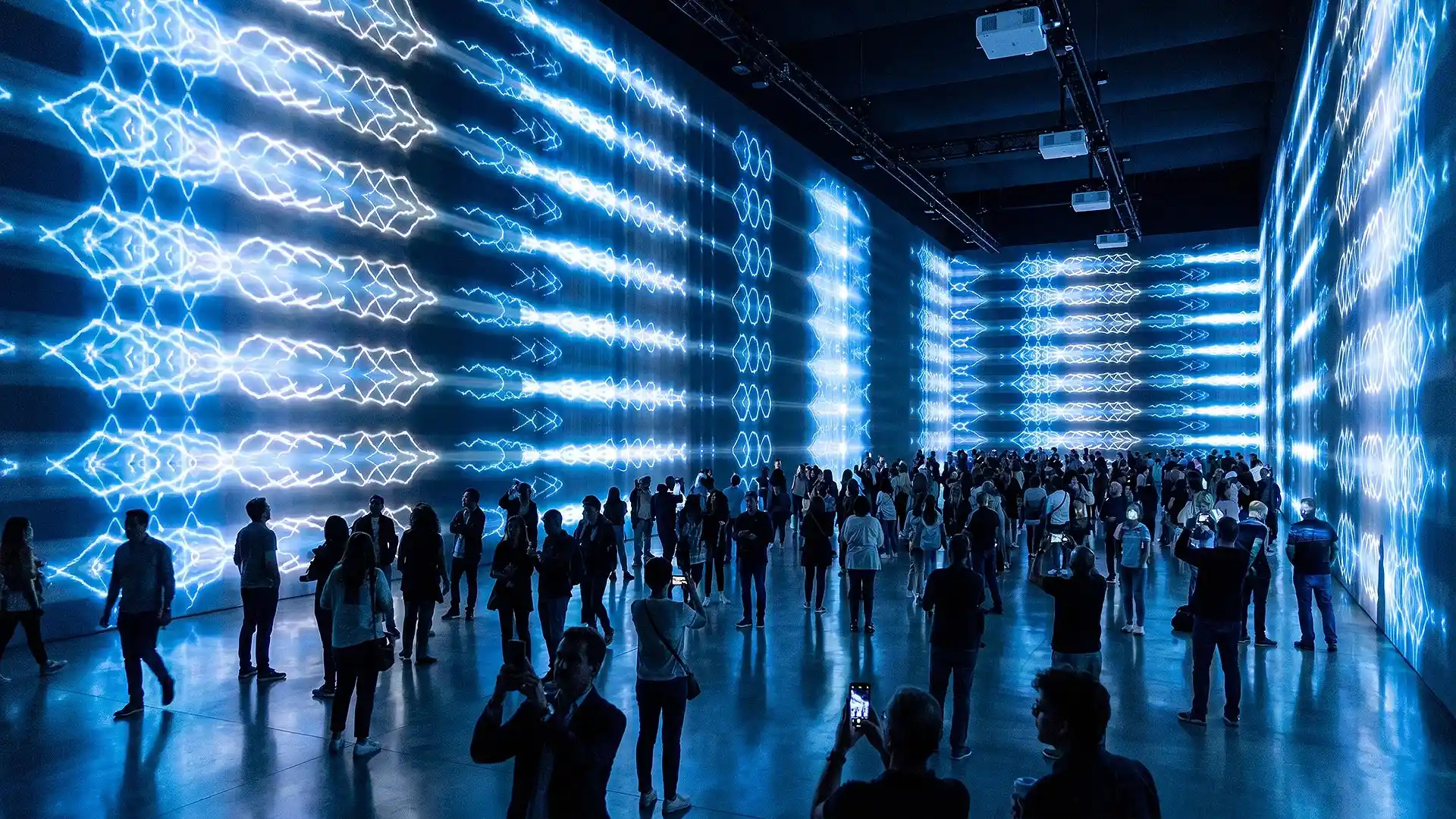
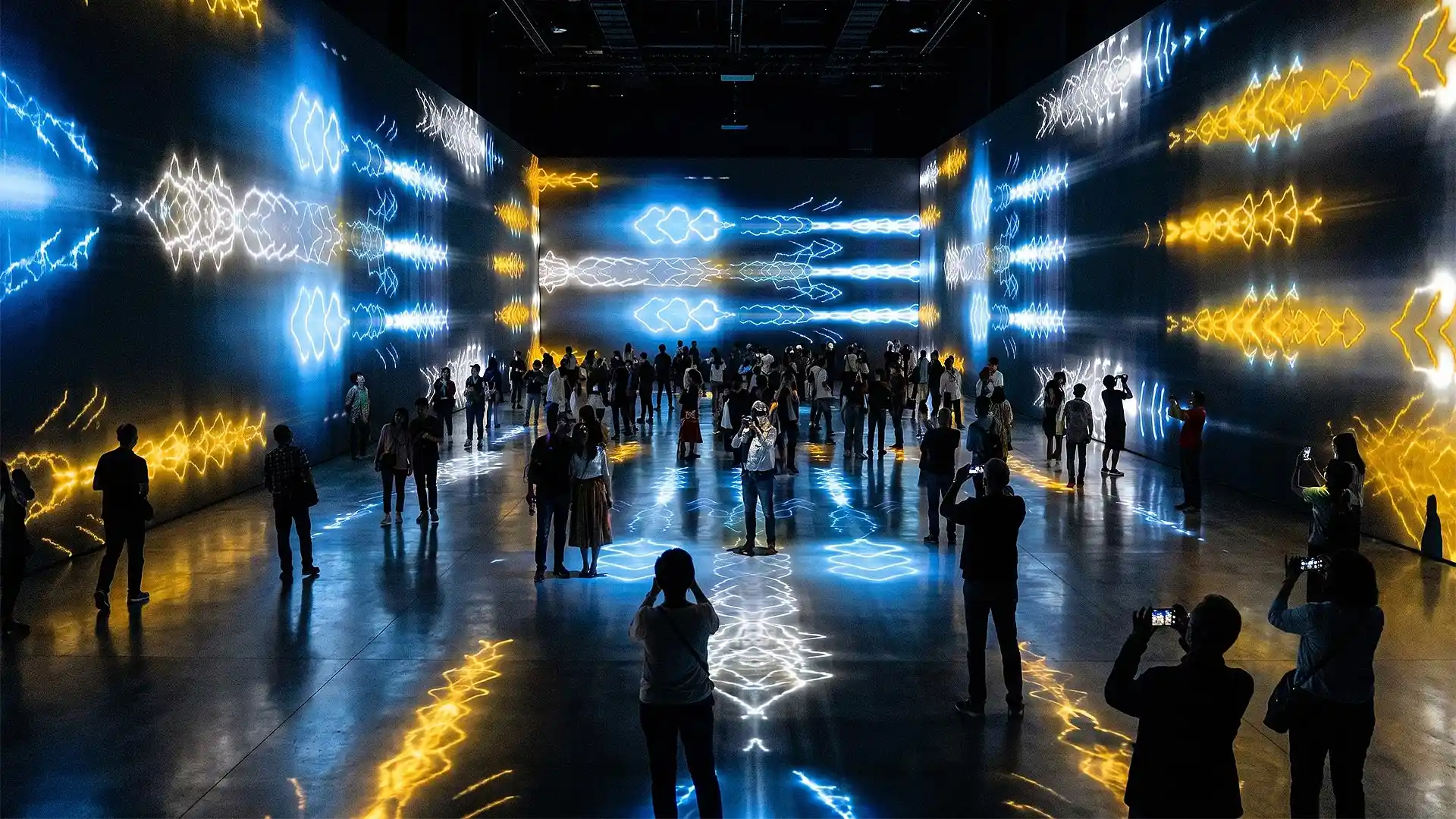
In an immersive room, a dome, a projected corridor or a retail installation, the audience stands one to four metres from the surface. Ambient light is controlled, so contrast is real and fine detail survives. And people look at the surface up close, deliberately, for minutes at a time — which is the opposite of a festival crowd glancing at a facade from forty metres.
At two metres from a projected wall, Full HD is visibly pixelated. Native 4K is the minimum professional standard for immersive interiors and it has been for several years. For domes and wrapped rooms built as multi-projector canvases, the total canvas frequently exceeds 8K even when no single projector does.
This is the split, and it is the single most important thing in this article: architectural mapping is a low-resolution, high-brightness discipline. Immersive interior work is a high-resolution, moderate-brightness discipline. They are moving in opposite directions and they need different content. Our Immersive Visuals and Fulldome Visuals exist as separate categories for exactly this reason.
The formats that are not in anybody’s spec sheet
The 4% who chose Ultrawide 5760×1080 in the poll are, in my view, the most interesting group in the data.
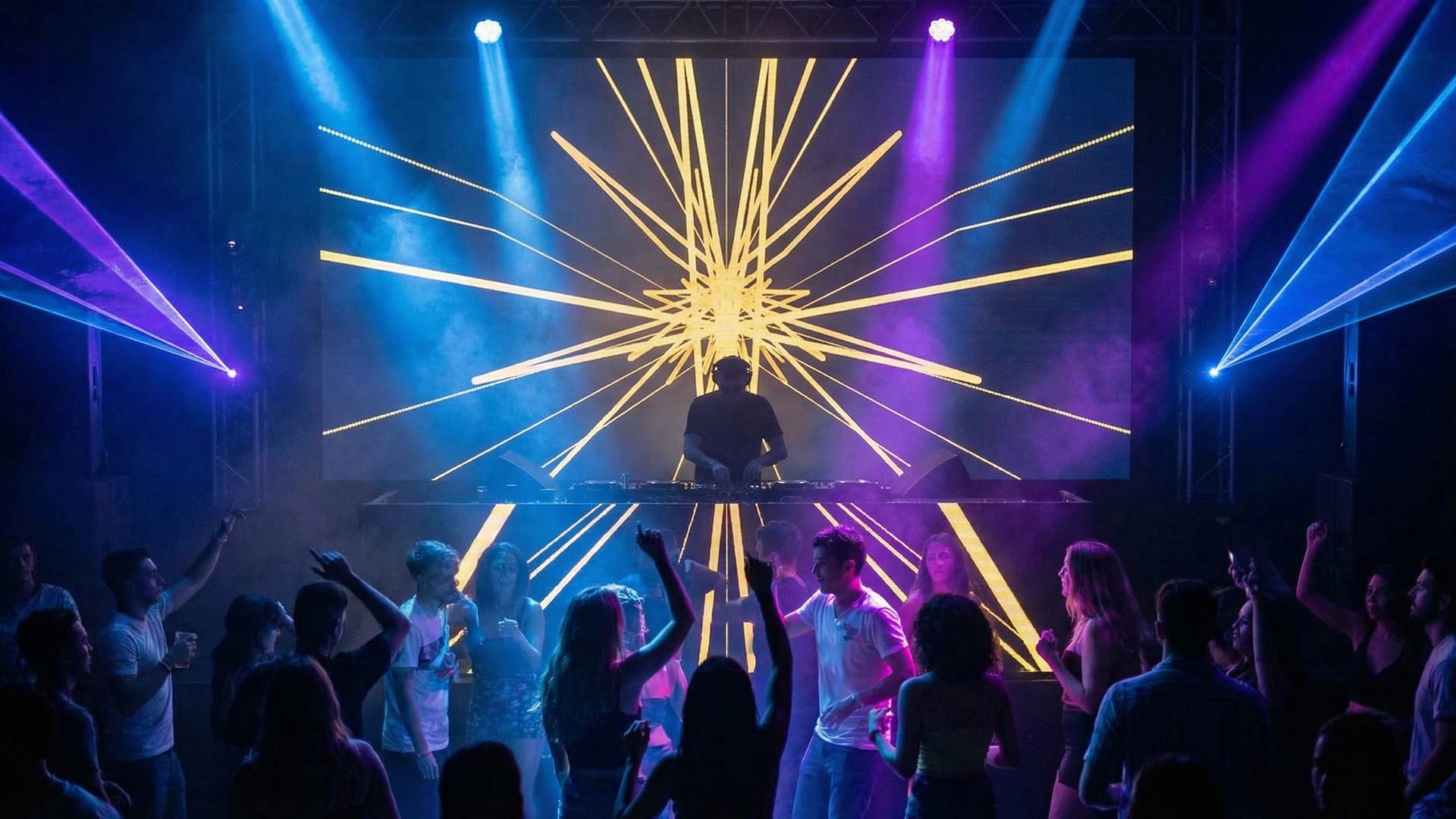
That is three Full HD frames side by side, and it exists because real screens are not 16:9. Triple-head club walls, stage backdrops with a 5:1 aspect ratio, LED ribbons, wrapped DJ booths, corridor projections. None of these have a standard resolution, and none of them ever will.
The practical consequence: your library needs to survive being cropped and tiled, not just scaled. Content designed to be centre-weighted breaks when you slice it into three panels. This is a design constraint, not a resolution one, and it matters more than the pixel count on most real jobs.
Immersive Visuals
Built for close-viewed interior surfaces where resolution matters
-
Sale!

 Select options This product has multiple variants. The options may be chosen on the product page
Immersive Projection Business Guide
Original price was: 19€.12€Current price is: 12€. -
Sale!
Interior Patterns – Immersive Visuals Vol.1
Original price was: 249€.199€Current price is: 199€. -
Deep Serenas – Immersive Visuals Vol.2
149€



The world is not one market
Everything above assumes a European or North American budget. Most of this industry is not that, and the resolution answer genuinely differs by region — for reasons that are structural, not cultural.
Why South and Southeast Asia adopt faster than their income level predicts
Here is a fact that explains a great deal: China produces over 70% of the world’s LED display modules, and Chinese manufacturers hold around 59% of the global mid-to-low-end segment. Average selling prices for standard panels fall 8–12% per year.
Proximity to that manufacturing base is worth more than GDP per capita. A venue in Bangkok, Ho Chi Minh City, Jakarta, Manila or Dhaka buys the same panel as a venue in Frankfurt without the freight, the import duty, the distributor margin or the currency spread. Shipping, lead times and after-sales support are all shorter.
The result is counterintuitive and, in our experience, real: fine-pitch LED is spreading through South and Southeast Asian venues faster than through parts of Southern and Eastern Europe, despite lower average event budgets. Content demand follows the hardware, so requests for 4K and above from that region have grown faster than we expected five years ago.
The same effect appears wherever the supply chain is short. It is a logistics story, not a wealth story.
The long Full HD tail, and why it deserves respect
Across most of Latin America, Africa, Central Asia and much of Eastern Europe, the installed base is coarse-pitch LED and Full HD projectors, much of it bought second-hand. That equipment has a ten-to-fifteen-year working life and there is no economic reason to replace it early.
Full HD is not a legacy format. It is the working standard for the majority of venues on earth, and it will remain so well into the 2030s. Anyone producing content for a global market who stops supplying 1920×1080 is not being forward-looking; they are removing themselves from most of the world.
The 1% who answered “HD 1280×720” in the poll were not making a mistake either. Somewhere there is a projector or a processor that outputs 720p and a VJ working professionally with it.
What this means if you produce content
Three practical conclusions:
Master high, deliver in tiers. Produce at 4K where the source allows, and supply Full HD and 4K versions. Downscaling is free; upscaling is not.
Do not abandon Full HD. Roughly two thirds of the addressable market ran it in 2022 and the installed base has not turned over.
Watch the LED pitch, not the calendar. The signal that a market is ready for higher-resolution content is P1.9 and finer arriving in mid-size venues — not the year on the calendar or what the trade press says about 8K.
Forecast about video resolutions to 2036
Labelled as a forecast, with the reasoning attached so you can disagree with it specifically.
2026–2029: the split hardens
Full HD stays significant but is no longer the default. I originally forecast 45–55% by 2029; the July 2026 poll already puts it near 38%, so I am revising that down to 30–40% by 2029. The installed base is turning over faster than I credited, and I was wrong about the pace.
4K becomes the default for anything indoors and close-viewed. Immersive rooms, retail, museums, corporate — 4K stops being a premium request and becomes the baseline spec.
Fine-pitch LED drives the real growth in high-resolution demand, not projection. As COB brings sub-1 mm pitches into normal budgets, mid-size venues acquire walls that genuinely need 4K and beyond.
8K stays a niche, appearing only on very large LED canvases and flagship immersive installations, and almost never as a single-file deliverable.
2030–2033: canvases, not resolutions
The useful shift in this window is conceptual. “What resolution is the show?” stops being a sensible question.
Large installations are already built as multi-output canvases — a 20-metre P1.5 wall is 13,333 pixels wide and no named format covers it. As that becomes normal at mid scale, production moves toward resolution-independent delivery: layered, tiled, procedurally scalable content assembled at the media server rather than a single flat file. Expect the practical formats to be Full HD, 4K, and arbitrary — with arbitrary growing fastest.
I also expect real-time and generative content to take a meaningful share of live visuals in this window, for the simple reason that a real-time system renders to whatever canvas it is given. That solves the resolution problem by removing it, and it is a more likely route to “8K shows” than 8K files ever were.
2034–2036: the ceiling is human, not technical
By the mid-2030s the binding constraint stops being manufacturing and becomes perception and economics.
At normal viewing distances there is nothing above 4K for a human observer to gain on any surface an audience does not press its face against. Fine-pitch LED will keep improving because the manufacturing curve is running, but the reason to buy it will be brightness, contrast, reliability and seamlessness rather than pixel count.
My expectation for 2036: Full HD still present but minority, roughly 20–30% of live work, concentrated in developing markets and legacy installs. 4K the global default at 50–60%. Above-4K canvases at 15–25%, almost entirely LED and immersive. Discrete 8K files remaining a marginal format throughout.
What we are actually betting on
We have to act on this, not just write about it, so here is our position. We produce in Full HD and 4K as standard across the catalogue, we hold Ultrawide and other non-standard aspect ratios because real screens demand them, and we treat 8K as a small experimental share rather than a growth area. If the LED market moves faster than we expect, that share increases. It has not yet.
If you want the reasoning behind the hardware side of this, our guide to projectors for video mapping covers why architectural and interior work need opposite machines.
8K is not the future of this industry
I want to be unambiguous, because a lot of marketing says otherwise.
LG Display stopped making 8K panels in January 2026. Samsung is the only major manufacturer left developing 8K television. Household penetration is 2–5%. There is almost no native 8K content anywhere, in any industry.
And yes, 8K rose in our own poll — from 2% in 2022 to 13% on Telegram and 4% on Facebook in 2026. I am not going to hide a number that argues against me. However, look at what that spread means: the two platforms disagree by more than three times on the same question on the same day, and the higher figure comes from a multi-select poll where somebody who has done one 8K job can tick it alongside their real working format. A number that unstable is a signal of interest, not of installed base.
None of this means very high resolution has no place. It means the route to it is fine-pitch LED canvases and immersive interiors, not a file format called 8K. If somebody sells you an “8K VJ pack” for a facade show, they are selling you storage and render time, not image quality.
Produce for the surface. The surface does not care what year it is.
What to actually render in, right now
Outdoor architectural mapping: Full HD or WUXGA. 4K only if the client’s technical spec demands it or the surface is unusually close and smooth.
Club and festival LED: measure the wall. Width in millimetres divided by pixel pitch is your real resolution. In most rooms that number is below Full HD.
Immersive interiors, domes, corridors, retail: 4K minimum, native. Build the canvas to the installation, not to a named format.
Ultrawide and non-standard screens: design content that survives cropping and tiling. This matters more than the pixel count.
Everything you sell or license: master at 4K, deliver Full HD and 4K. Two thirds of the world is still on the lower one.
8K: only when a specific canvas genuinely needs it, and then usually as a multi-output canvas rather than a single file.
The poll and the numbers
What resolution do most VJs use?
No longer Full HD alone. In our July 2022 poll of 567 VJs, Full HD took 65%. In the July 2026 re-run it fell to 34% on Telegram and 41% on Facebook, while the 4K family — UltraHD 3840×2160 plus DCI 4K 4096×2304 — reached 36% and 45% respectively. On both platforms the 4K family is now at or above Full HD.
Is 4K worth it for projection mapping?
For outdoor architectural mapping, usually not. Contrast, not pixel count, is the limit on a facade at night — fine detail disappears into ambient light and surface texture regardless of resolution. Panasonic sells the PT-RZ34K, a WUXGA-output version of a 4K projector body, specifically because of this. For immersive interiors where the audience is within a few metres, 4K is the minimum standard.
Surfaces and formats
What resolution is my LED wall actually?
Physical width divided by pixel pitch. A 4-metre wall at P3.9 is 1,026 pixels wide, so Full HD already oversupplies it. A 10-metre wall at P1.5 is 6,667 pixels wide and needs more than 4K. Measure before you render.
How far should the audience be from an LED wall?
As a working rule, minimum viewing distance in metres is roughly the pixel pitch in millimetres, and the optimal distance is about 2.5 times that. A P3.9 wall wants at least 3.9 metres and looks best around 10; a P1.5 wall works from 1.5 metres.
Is 8K coming to VJing?
Interest is rising, installed base is not. Our polls moved 8K from 2% in 2022 to 13% on Telegram and 4% on Facebook in 2026 — a spread of more than three times on the same day, which says the number is unstable. Meanwhile LG Display ceased 8K panel production in January 2026 and household penetration sits at 2–5%. Very high resolution will arrive through fine-pitch LED canvases and immersive rooms, usually built as multi-output canvases rather than as a single 8K file.
Should I still produce content in Full HD?
Yes, but it is no longer the primary target. It fell from 65% in 2022 to roughly 38% in 2026, so it is now one format among several rather than the default. The installed base across Latin America, Africa, Central Asia and much of Eastern Europe is still coarse-pitch LED and Full HD projectors with a decade of working life left. Master at 4K and deliver both.
Why does higher resolution adopt faster in Southeast Asia than in parts of Europe?
Proximity to manufacturing. China produces over 70% of the world’s LED modules and Chinese makers hold around 59% of the mid-to-low-end segment, with prices falling 8–12% a year. Venues near that supply chain buy the same panels without freight, duty, distributor margin or long lead times, so fine pitch spreads faster than average event budgets would suggest.
Method and reliability
Why did the 2026 Telegram and Facebook polls disagree?
Mostly because of the labels. Facebook put UltraHD 3840×2160 at 38% and DCI 4K 4096×2304 at 7%; Telegram reversed it at 14% and 22%. Few working VJs distinguish those two reliably, so people pick whichever line reads as “4K”. Combine the rows and the platforms agree: the 4K family sits at 45% on Facebook and 36% on Telegram. The Telegram poll also allowed multiple answers, which inflates smaller formats.
How reliable are these poll numbers?
Directional rather than precise. The 2022 poll had 567 votes; the 2026 Telegram run had 82 voters casting 113 votes, and Facebook published percentages without vote counts, so the two cannot be weighted together. Treat individual percentages as approximate. What survives every caveat is the direction and its size: Full HD lost roughly 27 points and the 4K family gained roughly 16.
What about ultrawide and other non-standard resolutions?
They are permanent, not transitional. Triple-head club walls, 5:1 stage backdrops, LED ribbons and wrapped booths have no standard format and never will. Design content that tolerates cropping and tiling rather than trying to match a named resolution.
Sources
Poll data is our own. Market figures were taken from the sources below and checked in July 2026.
Our own data
- LIME ART GROUP resolution poll, July 2022, 567 votes, conducted across our VJ community channels
- Production and sales observations from our own catalogue since 2012
Display and LED market
- Research on 8K display adoption and panel production, including LG Display’s exit from 8K panel manufacturing in January 2026
- Small pixel pitch and fine pitch LED market analyses
- LED display industry pricing and manufacturing share reports
- Pixel pitch and viewing distance guidance from LED display manufacturers and integrators
Hardware references
- Panasonic Connect — PT-RQ35K and PT-RZ34K specifications
- ProjectorCentral — projector database
The forecast to 2036, the surface-first argument and the regional adoption observations are our own analysis and are labelled as such in the article.
Help me improve the next number
The 2026 poll is done and its results are above. However, it was smaller than the 2022 one, and I would rather the next run were bigger — because the value of this data is entirely in the sample.
Vote when it goes out. The poll runs in our VJ communities. Add an option if the one you use is not listed — somebody added 720p in 2022 and PAL in 2026, and both turned out to be among the more interesting results.
Tell me the surface, not just the format. The most useful thing I could add next time is a second question: what are you projecting onto? Resolution without surface is half a data point, and this article exists because the surface is what actually decides the answer.
In the meantime, our VJ Loops Packs ship in Full HD and 4K, Immersive Visuals are built for close-viewed interior surfaces, and the ultrawide and non-standard formats are in there too — because the screens in real rooms have never matched the formats in the spec sheets.
Latest Feature VJ Loops
Hand-picked visuals by our New Media Artists
-
Deep Serenas – Immersive Visuals Vol.2
149€ -
Sale!
VJ Loops Pack Vol.73 – Mirror Ballet
Original price was: 129€.99€Current price is: 99€. -
VJ Loops Pack Vol.18 – Abstract Background Textures
89€ -
VJ Loops Pack Vol.19 – Lovely Red
79€ -
VJ Loops Pack Vol.11 – Really Madonna
89€ -
Sale!
Interior Patterns – Immersive Visuals Vol.1
Original price was: 249€.199€Current price is: 199€. -
VJ Loops Pack Vol.85 – Gnosis Lightning
99€ -
VJ Visuals Starter Pack
99€ -
Sale!
Select options This product has multiple variants. The options may be chosen on the product page
Immersive Projection Business Guide
Original price was: 19€.12€Current price is: 12€.






Best wishes from Vienna,
Thanks for your attention, faithfully yours,
Alexander Kuiava – Founder & CEO LIME ART GROUP
https://alexanderkuiava.com/
