
DJ and VJ Collaboration — How Visuals Became the Format
The article is written by a human. Mistakes have been edited by AI.
Market figures and product details checked July 2026.
In December 2024 an electronic artist sold 137,000 tickets and grossed $21 million across eight nights at Sphere in Las Vegas. Not a band. A DJ. The music was already good before the residency — what changed was that the show became a thing you had to be inside to experience, and a thing that travelled across every feed on earth the next morning.
That is the whole argument of this article, and it has consequences for anyone who plays records for a living.
Who this article is for: DJs who have good tracks and a set that looks like every other set, VJs and motion designers who want to work with artists rather than for venues, and promoters deciding where the production budget goes.
What it solves: the visual side of a DJ career is now a competitive requirement, and almost nobody explains what the working relationship between a DJ and a VJ actually looks like.
What you get by the end: what the Anyma case really proves, what the club and LED markets are doing underneath it, the three working models of DJ–VJ collaboration, and the specific tools and content that let you build a visual identity without a Sphere budget.
Hello dear VJs, DJs and clients of LIME ART GROUP. I am new media artist Alexander Kuiava. I performed as a VJ for years before I stopped, and our studio has been producing visuals for DJs, clubs and festivals since 2012. Most of what follows is uncomfortable for both sides of this partnership, which is usually a sign it is worth writing down.
Why a DJ set now needs a visual identity
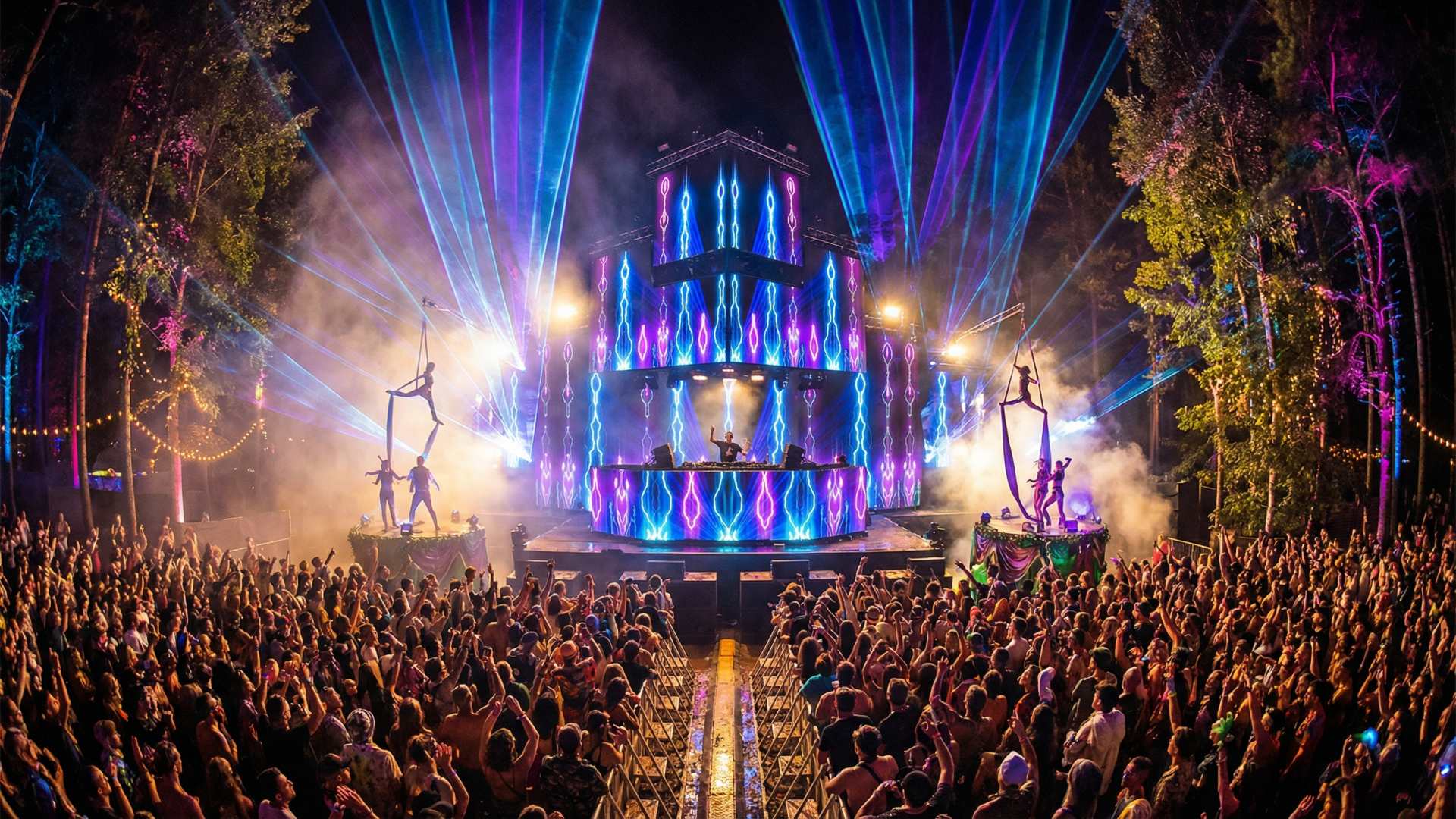
Ten years ago the visuals were decoration. The DJ was the show and the screen behind them was atmosphere — abstract loops, some strobes, the promoter’s logo. Nobody chose a night because of the screen.
That relationship has inverted at the top of the market and is inverting everywhere else. A DJ set is now a format, and a format needs a look. Not because the music matters less, but because the music alone no longer differentiates you: every DJ has access to the same catalogue, the same stem separation, the same AI mastering, and the same distribution. Sound is table stakes. What is scarce is a recognisable world.


The Anyma case, with the actual numbers
Anyma — Matteo Milleri — became the first electronic music artist to headline a residency at Sphere in Las Vegas. “Afterlife Presents Anyma: The End of Genesys” opened on 27 December 2024. The first eight dates sold 137,000 tickets and grossed $21 million, according to figures reported to Billboard Boxscore. The run was extended and finished at twelve shows in February and March 2025.
For context, Sphere as a venue posted over $420 million in revenue in 2024 across all its residencies including U2, the Eagles and Phish. An electronic act put a substantial dent in that with a show built around a visual universe.
What is worth studying is not the budget. It is the credit list. The show had a visual co-creative director and art director, Alessio De Vecchi. It had a head creative and stage designer, Alexander Wessely. It had an animation studio, Woodblock, on additional production. The visual side of that production was staffed like a film, not like a lighting rig.
And the show has a character. A female cyborg figure who, at a specific moment, breaks through a wall of glass. Audiences cheer at a rendered character doing something. That is not a visualiser. That is narrative, and it is why the footage travelled.
What everybody copying it gets wrong
Since 2025 a large part of the motion design world has been producing the same thing: photoreal chrome humanoids, monolithic ancient-futurist architecture, slow orbital camera moves, desaturated palettes with one accent colour, and a sense of religious scale. It is genuinely well made and it is now everywhere — on Instagram, in stock libraries, in pitch decks, and behind DJs in rooms that hold four hundred people.
The imitation misses the point in three specific ways.
One: the aesthetic was downstream of an identity, not upstream. Anyma had a defined world — a specific relationship between machine and human, carried consistently across two albums, the artwork, the live show and even the NFT work that preceded it. The visual style is the surface of that. Copying the surface produces something that looks expensive and means nothing, which the audience registers within about forty seconds.
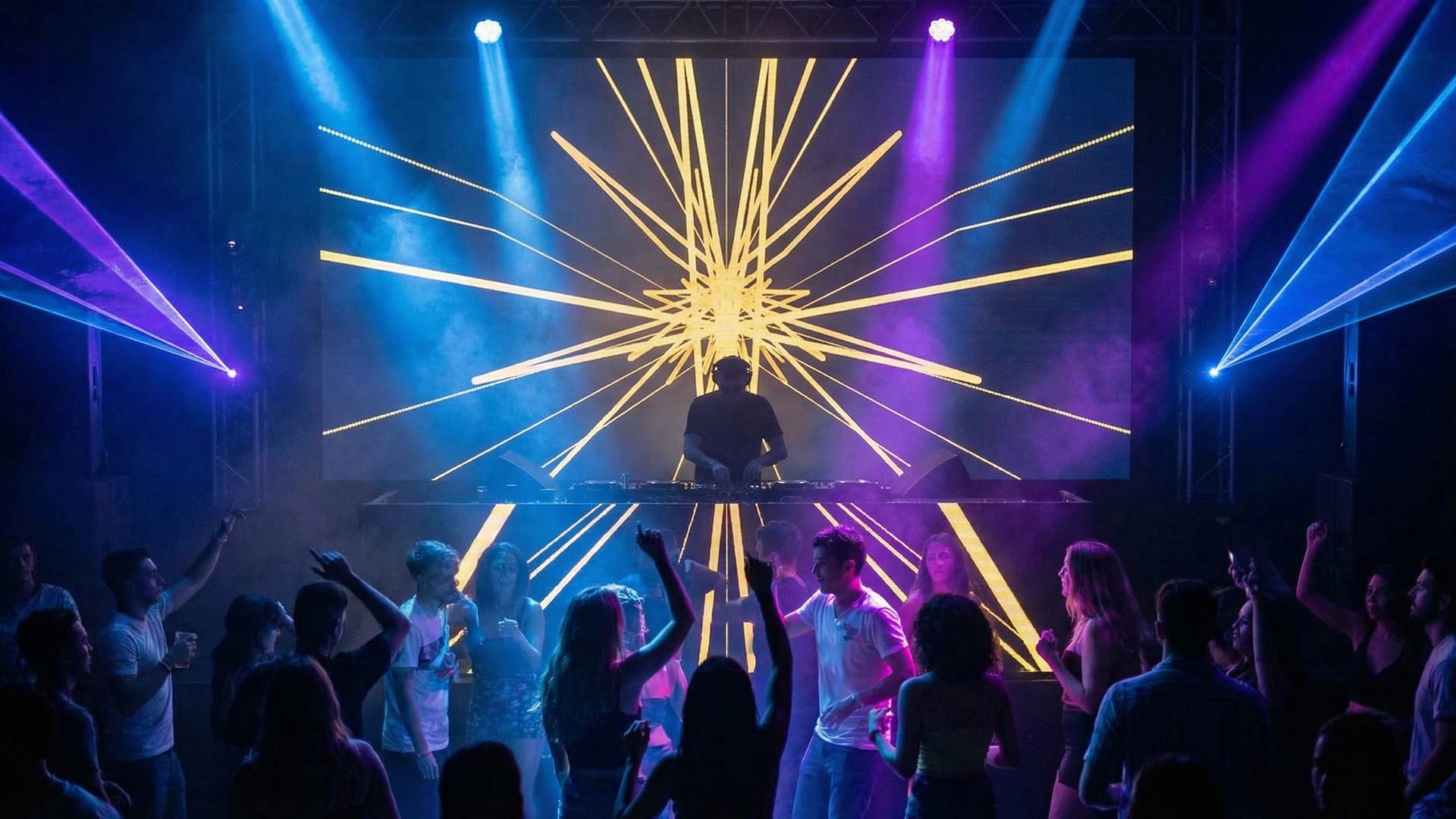
Two: it was made for a 16K wraparound screen. Photoreal, slow, high-detail 3D reads beautifully at that scale and in that resolution. On a 4-metre LED wall behind a DJ booth, at P3.9 pixel pitch, from six metres away, with a smoke machine running, it reads as a grey blur. Content has to be designed for the surface it will actually be shown on, and most of the copies are designed for the surface they were inspired by.
Three: photoreal 3D is the most expensive way to look generic. A single hero shot of a chrome figure costs more to produce than an entire night of graphic, high-contrast, rhythm-driven visuals that would read better in the actual room. Spending your whole production budget imitating a look that six hundred other artists are also imitating is the worst return available.
The correct lesson from Anyma is not “make chrome cyborgs”. It is: decide what your world is, staff the visual side seriously, and build content designed for your actual screen.
The format is the product now
Look at what has been announced across the scene in the last two years and a pattern is obvious: artists are launching named audiovisual shows rather than tours. A show has a title, a concept, a visual director, and it gets booked as a piece of programming rather than as a DJ slot. Miss Monique announced a debut audiovisual live show. Afterlife built an entire brand on a consistent visual language before Sphere ever called.
This matters commercially, and here is the mechanism. A promoter booking a DJ is buying two hours of music at a market rate that everyone knows. A promoter booking a show is buying a piece of programming they can market, photograph, sell a higher ticket for and put on a poster. The second is not priced against other DJs. It is priced against other entertainment.
The industry has an outside measure of this too. In its Live Events Outlook 2026, the media server company Disguise observed that a show’s impact is now often measured by how well it travels across social feeds, and that audiences increasingly treat concerts as cultural events worth crossing borders for. A set that produces no footage worth posting is, in 2026, a marketing failure regardless of how well it was mixed.
VJ Clips
Single clips and loops for club and festival screens
-
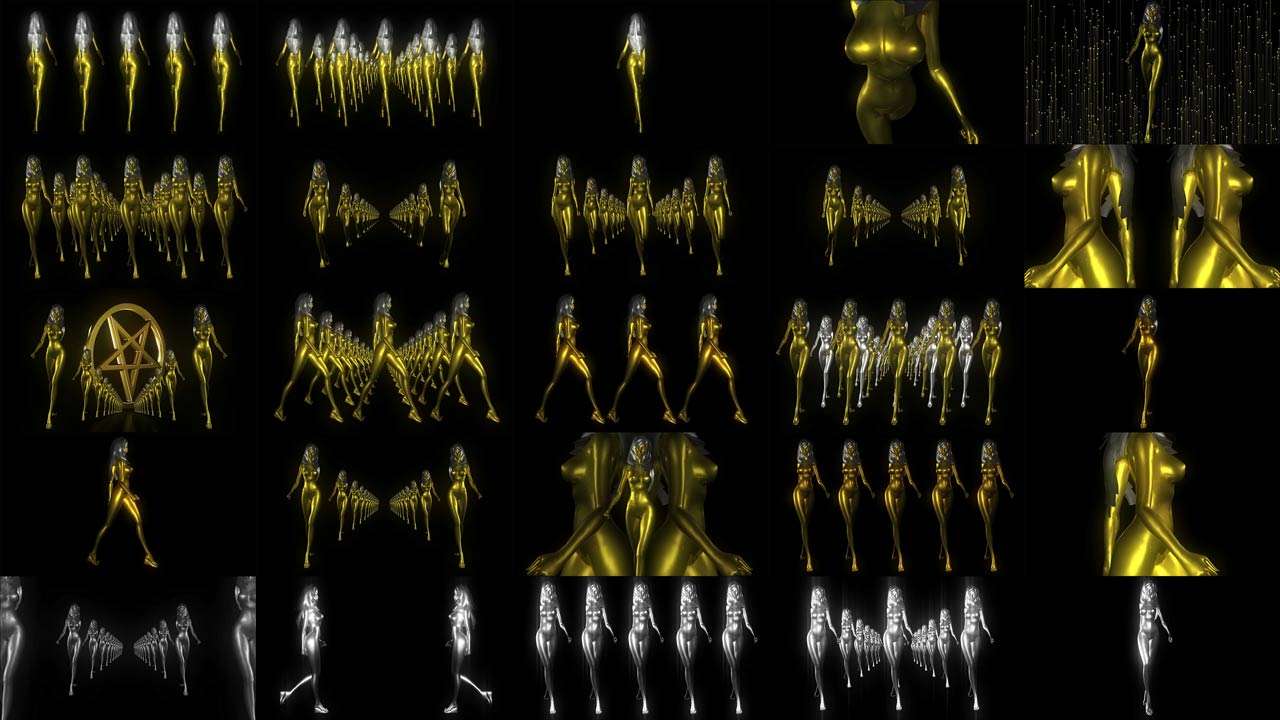
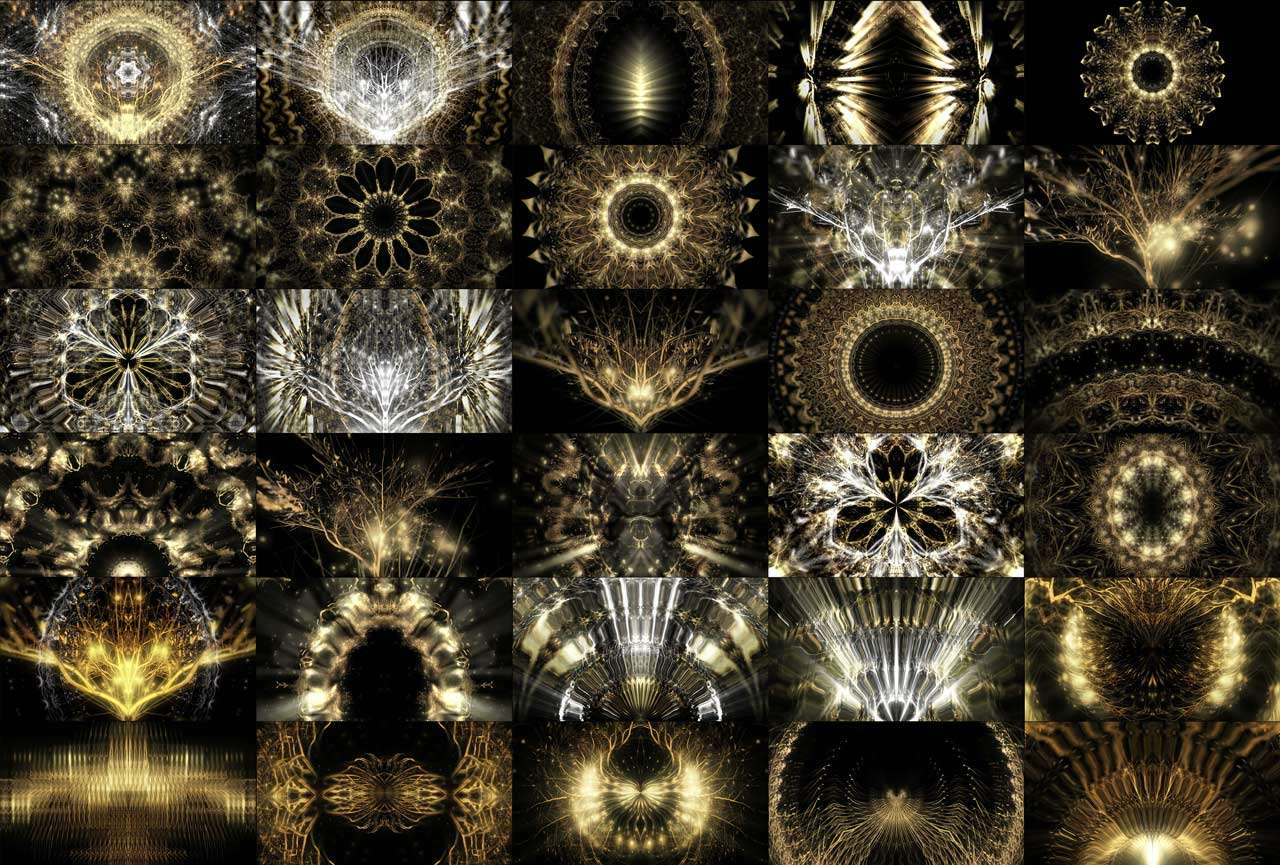
VJ Loops Pack Vol.41 – Goldfrau
79€ -
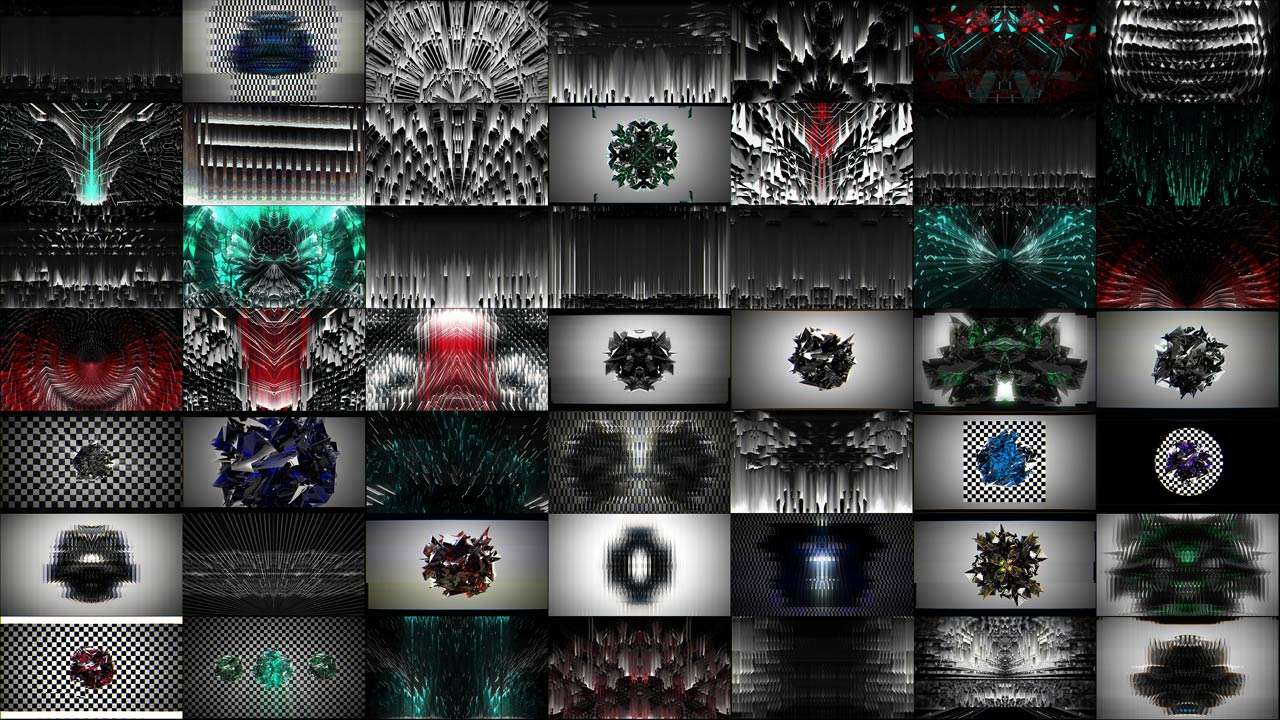
VJ Loops Pack Vol.29 – Glitch Backgrounds
89€ -
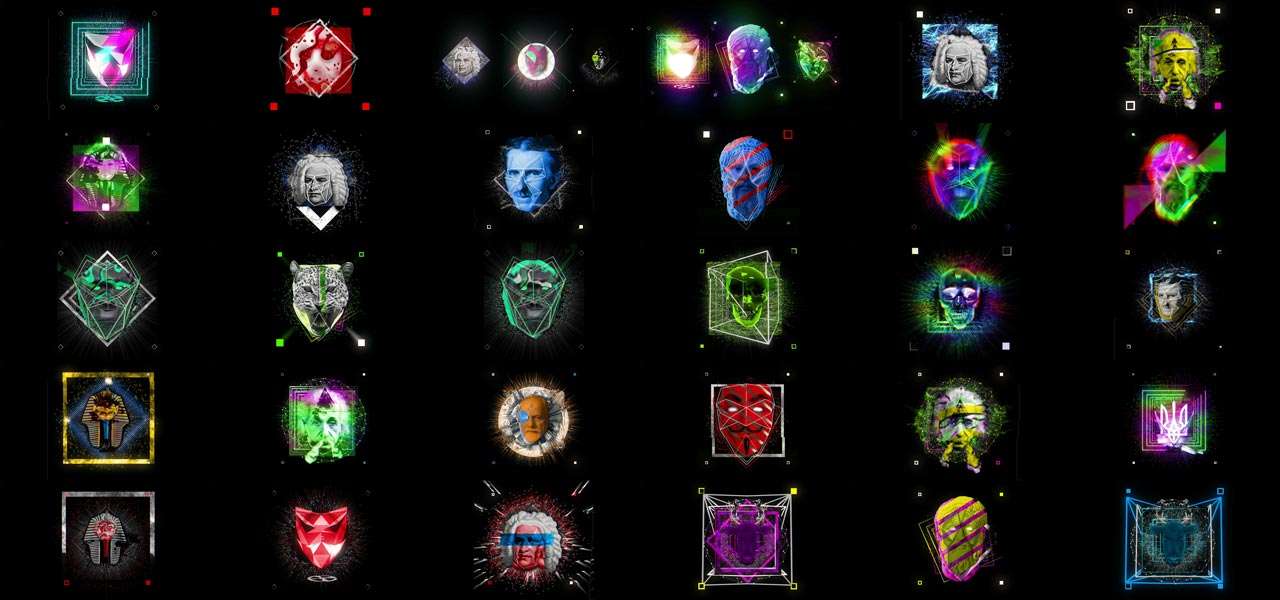
VJ Loops Pack Vol.17 – Main Element
99€ -
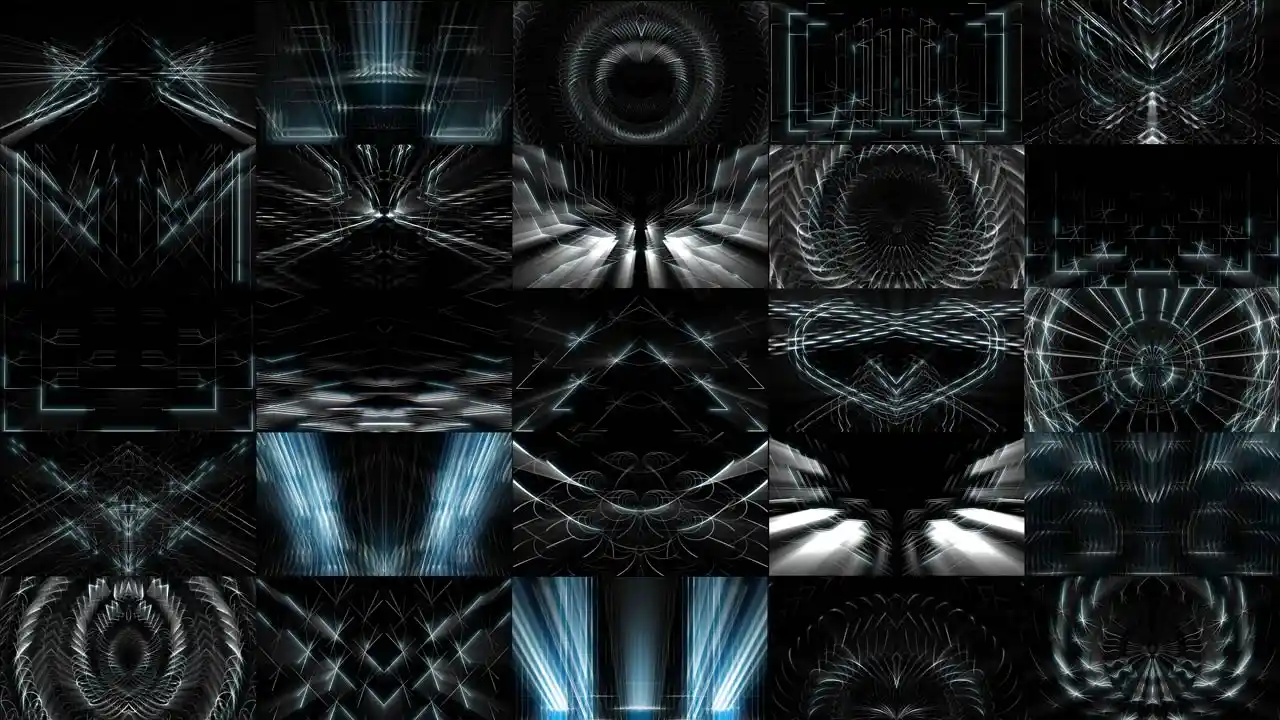
VJ Loops Pack Vol.28 – DecoLines
99€ -
VJ Loops Pack Vol.18 – Abstract Background Textures
89€ -
VJ Loops Pack Vol.11 – Really Madonna
89€ -
VJ Loops Pack Vol.12 – Interstellar Hypergate
59€ -
VJ Loops Pack Vol.1 – Smart Lines
99€ -
Vj Loops Pack Vol.26 – Gilded Roots
99€









Where the money and the screens actually are
Three market shifts sit underneath all of this, and they point in the same direction.
Nightclubs: the room is shrinking, the culture is not
The honest numbers first, because the club scene is where most DJs and VJs actually work.
The UK — which has the best-documented night-time economy in Europe — has lost 36% of its nightclubs since March 2020, falling from 1,283 venues to 823 in 2025. That is a 3% decline in the last year alone, on top of everything before it. 26% of towns and cities that had a nightclub in 2020 now have none at all, and 16% have lost every late-night venue. Across all late-night sites — bars, clubs, casinos — the sector has shrunk by nearly 29% in six years, roughly three net closures a week.
Now the other half, which almost nobody quotes alongside it. UK electronic music generated £2.47 billion in measurable economic activity in 2025, up 3% year on year, according to the Fourth UK Electronic Music Industry Report published by the NTIA with Audience Strategies and Amazon Music in February 2026.
Read those two facts together, because they are the whole story. The rooms are closing and the culture is growing. The money did not leave. It moved — to festivals, to large-format shows, to warehouse and one-off events, to online consumption, and to a smaller number of bigger venues.
What that means for anyone reading this: the small dark room where nobody looked at the screen is disappearing. The formats that are growing are exactly the ones where the visual production is part of the product — festivals with stage design, branded events, large-format shows, and content that lives online after the night ends. The share of DJ work that requires a visual is going up even as the number of clubs goes down.
LED walls: the screen became the cheap part
Meanwhile the hardware got dramatically cheaper, and this is the single most underrated shift in this industry.
The global LED display market is projected at roughly $9.86 billion in 2026. China produces over 70% of the world’s LED display modules, and Chinese manufacturers hold around 59% of the global mid-to-low-end segment — the segment that ends up in clubs, bars, small festival stages and rental inventories. Average selling prices for standard-resolution panels are falling 8–12% per year, on top of a roughly 50% drop over the five years to 2021. Fine-pitch indoor screens below P1.5 mm are the fastest-growing category at about 24% annually.
Translated out of market-research language: an LED wall that was a five-figure capital decision for a mid-size club in 2018 is now an ordinary fit-out line item. Rental companies in every European city carry stock. A regional promoter can put a 5×3 metre wall behind a booth for a Saturday without a serious conversation.
Which produces a specific and very current problem. Thousands of venues now own screens they have nothing good to put on. Walk into a mid-size club in almost any city and the wall is running a stock visualiser, a looping logo, or a plasma effect from 2011 — on hardware that cost real money. The scarce resource flipped from the screen to the content, and most of the market has not caught up.
For a DJ this is an opportunity that costs almost nothing to take. The venue already has the wall. If you arrive with your own visual set, on a drive, correctly encoded, you look like an artist with a show while the DJ before you looked like a playlist. The delta in perceived professionalism is enormous and the delta in cost is a few hundred euro of content.
Where the event money is going
The wider numbers confirm the direction. The global event market is estimated at about $1.6 trillion in 2026, projected toward $4.5 trillion by 2035. The US live events market alone sits near $490 billion in 2026, heading to $660 billion by 2033. Immersive entertainment specifically is modelled to grow from around $140 billion in 2025 to $260 billion by 2031, and experiential marketing from $55.5 billion in 2026 toward $71 billion by 2035.
Treat any single one of those forecasts with suspicion — market research firms disagree with each other constantly, and we said so in our article on projection mapping costs. But the direction is consistent across every source: spending is moving toward experiences that are immersive, visually produced and worth documenting. Not toward more DJs playing to a dark room.
How DJs and VJs actually work together
Everything above is context. This is the part almost nobody writes down: what the working relationship looks like in practice.
The three models, and what each costs
| Model | What it is | Works for | Realistic cost |
|---|---|---|---|
| Venue VJ | The club’s resident VJ plays generic visuals to whoever is on | Weekly club nights, no artist branding | Included in the venue fee |
| Curated set | The DJ supplies their own content library; a VJ or the DJ triggers it live | Touring DJs, residents building an identity | €200–€2,000 for a content library, reusable forever |
| Commissioned show | Bespoke content built to the artist’s concept, with a visual director | Named audiovisual shows, festivals, album launches | €5,000–€100,000+ |
Most DJs reading this belong in the middle row and try to jump to the third. Build the curated set first. It costs a fraction, it is reusable across every gig, and it teaches you what your visual identity actually is — which is the information a commissioned show needs before it can be briefed properly.
What the VJ needs from the DJ, and never gets
I have been on this side. Here is what makes the difference between visuals that follow the music and visuals that fight it:
The set structure, in advance. Not the tracklist — the shape. Where the intro ends, where the first build is, where the peak sits, where the breakdown is. A VJ who knows a drop is coming at minute 34 can build to it. A VJ discovering it at minute 34 is always half a bar behind.
BPM range and key changes. Loops have their own tempo. A loop cut at 128 running under a 140 track looks wrong in a way most people cannot name but everyone feels.
Two or three reference images, not a genre. “Dark techno” tells a VJ nothing. Three screenshots and one sentence about what the world is tells them everything.
Your logo as a white PNG. Projectors and LED walls throw white brightly and black as nothing. Half the logos we receive are dark blue and effectively invisible.
Advance notice of the surface. A 16:9 screen, a 32:9 ultrawide, three separate panels and a wrapped DJ booth are four different content formats. Finding out on the night means stretched content.
What the DJ needs from the VJ, and rarely asks for
Restraint. The most common failure in club visuals is too much happening. The audience is looking at the artist most of the night; the screen’s job is to hold the room between peaks and detonate on cue, not to compete for attention continuously.
A visual identity, not a folder of clips. Twelve unrelated beautiful loops produce a set that looks like a screensaver rotation. Six related ones, with a consistent palette and a consistent motion language, produce a world.
Cue discipline. Scenes stored, transitions timed, one key to advance. A VJ dragging clips live during a peak is gambling with the artist’s biggest moment.
Honesty about the room. A good VJ will tell a DJ that the photoreal 3D they paid for will not read on that wall from that distance. Most will not, because it is an awkward conversation. Have it anyway.
Build a world, not a playlist
The practical definition of a visual identity is narrower than people think. It is four decisions:
A palette. Two or three colours, held across everything. Anyma is essentially monochrome with one warm accent. That constraint is why the footage is recognisable in a thumbnail.
A motion language. Slow and orbital, or hard-cut and strobing, or fluid and organic. Pick one. Mixing all three reads as indecision.
A recurring object or symbol. A figure, a shape, a mask, an architectural motif. This is the single highest-return decision and the one most skipped. People remember a thing, not a texture.
A rule for the peaks. What happens visually when the drop lands, and only then. If everything is intense the peak has nowhere to go.
You can execute all four with licensed content. You do not need bespoke 3D to have an identity — you need consistency, which is a curation decision, not a budget decision.
DJ.Studio: building the mix and the visuals on one timeline
There is a specific tool that has quietly made this much easier, and it is worth a section of its own because it changes the workflow rather than just adding a feature.
DJ.Studio is a timeline-based DAW for DJs — Mac and Windows, from DJ.Studio B.V., with over 250,000 users. Instead of recording a live performance, you arrange the whole set on a timeline: tracks, transition points, EQ and filter automation, effects, stem separation. It is the difference between performing a mix and composing one.
The parts that matter most in practice:
Harmonize orders a playlist automatically using BPM and Camelot-wheel harmonic matching, then lets you override it. For building a two-hour promotional mix, this removes the single most tedious hour of the job.
Transitions are editable objects. You can stack multiple effects on one transition, draw your own automation, and drop in your own samples — things that are simply not possible while performing live on two decks.
It reads your existing library. rekordbox, Serato, Traktor, Virtual DJ, Engine DJ, Mixed In Key and Apple Music all connect, so you are not rebuilding your collection. With a Mixed In Key licence you also get your existing cue points, key detection and energy levels inside the timeline. Finished sets can be exported to Ableton Live, or straight to Mixcloud with an auto-generated tracklist.
And then there is the video lane, which is the reason this belongs in an article about VJing.
Underneath the audio timeline, DJ.Studio has a dedicated video track. Per song, you choose the background type — an animation preset, a Shadertoy 3D scene, the album art, a solid colour, an image, or your own video file. On top of that you layer track information, spectrum analysers, particles, transitions and global text or logo overlays. There is an “apply settings to all tracks” function so a long set gets a consistent look in one action. The library includes around a hundred audio-reactive animation presets plus a hundred Shadertoy-based 3D backgrounds.
Export is MP4 or WebM, up to 4K, landscape or portrait for Shorts and vertical feeds. And there is an “Export description for YouTube” button that generates your full tracklist with HH:MM:SS timestamps, ready to paste — which turns into clickable chapters and gives every artist in your set visible credit.
Two practical notes before you buy. Video creation and video export are on the Ultimate licence only — the lower tiers can preview the video engine but not render files. And DJ.Studio sells both a subscription and a one-time perpetual licence for one user on two machines, with twelve months of updates and support included.
Where our loops fit — and why the defaults are a trap
Here is the honest problem with any built-in visual library, including a good one: 250,000 people have the same presets.
If you build your promotional mix with the default animation backgrounds, your video looks like every other DJ.Studio video, which is precisely the opposite of what a visual identity is for. The presets are excellent for learning the workflow and fine for a radio show. They will not make you recognisable.
The fix is built into the software: the background type per track can be video. Drop in your own clips and the same timeline that gave you a fast, well-mixed set now gives you a set that looks like yours.
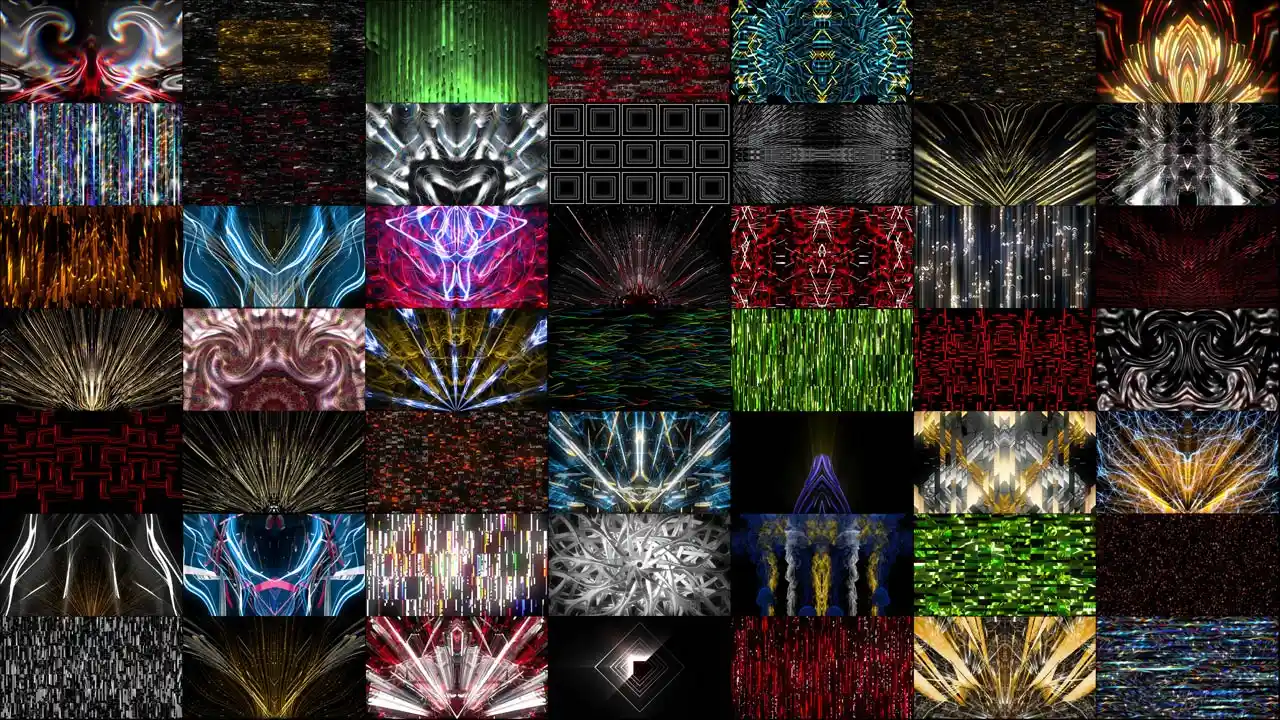
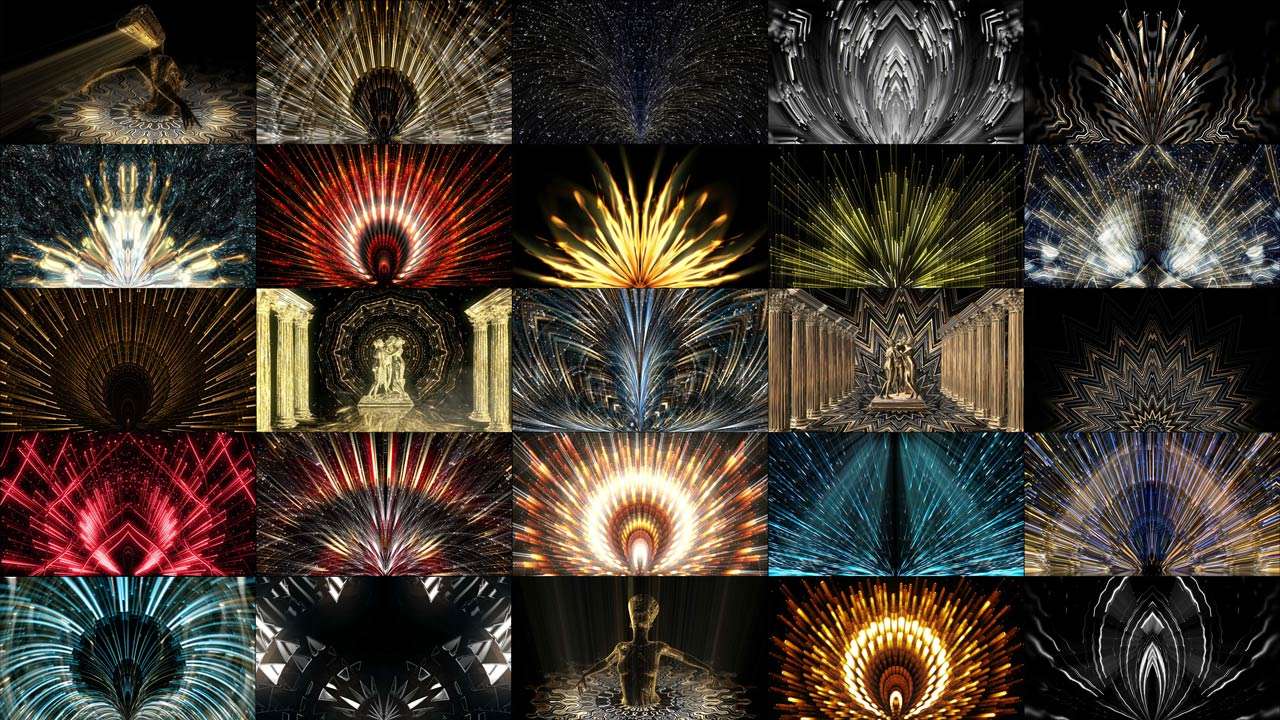
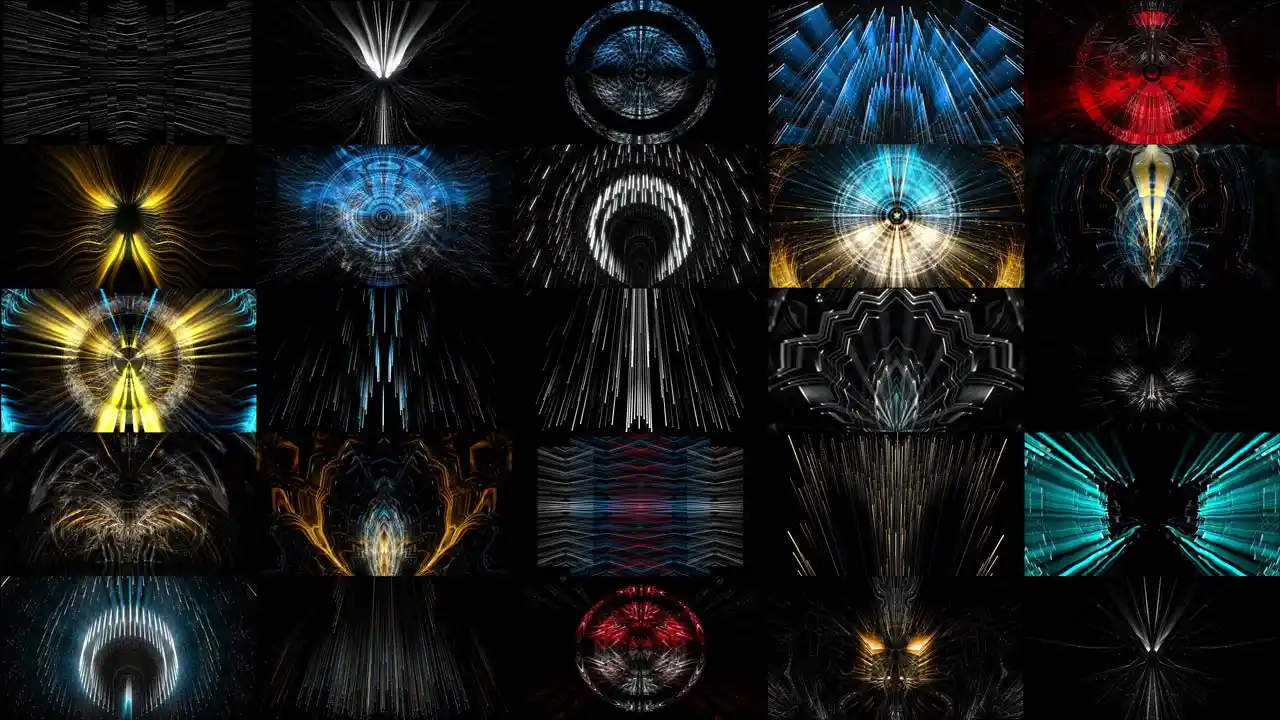
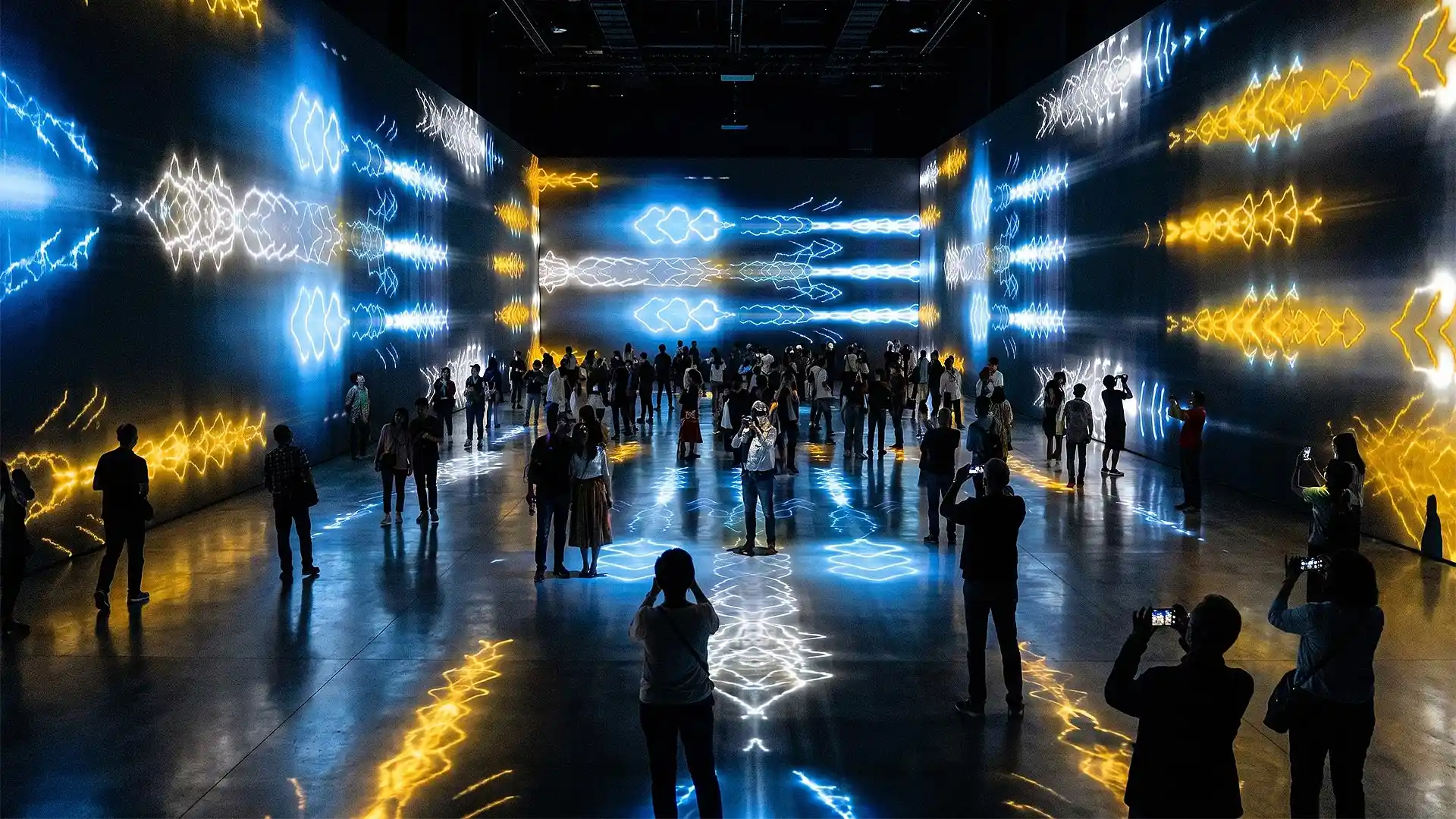
That is exactly what our libraries are for. Our VJ Loops Packs and VJ Clips are produced as coherent collections rather than isolated files — 20 to 40 clips sharing a palette and a motion language, which is precisely what you need to make a two-hour video read as one piece. AI Visuals cover the newer generated aesthetics, and Immersive Visuals are built for wide and wrapped screens.
And the same files do double duty. The clips you use as backgrounds in your YouTube mix are the clips you play on the club wall. One licence, one visual identity, two outputs — the online artefact and the live show. That consistency is what makes people recognise a set they have never seen before, and it is available to a DJ with a €200 content budget and a laptop.
What we do: VJ mixes and VJ sets
Most content libraries sell clips. We build sets, and I think we build the best VJ mixes and VJ sets in Europe. That is a claim, so here is what it rests on.
Since 2012 we have produced over a hundred VJ loops packs, used by more than 30,000 artists and companies in over 100 countries. But the part that matters is not the volume — it is that our packs are produced as sets: a collection with one visual world, consistent colour, consistent motion, and enough variation to carry a full night without repeating. That is a different production discipline from making individually attractive clips, and very few libraries do it, because it is slower and harder to market file by file.
A VJ set is content built to be performed: 20–40 related clips, correctly encoded, with enough range to cover intro, build, peak and breakdown, in a coherent world.
A VJ mix is that content already arranged into a timed sequence — the visual equivalent of a DJ mix, cut to a track or a set, ready to run.
Both are available as packs, as Big Bundles when you need a whole library at once, and as HDD kits when you need everything. Everything is royalty-free for commercial performance, which means one purchase covers every gig you will ever play.
If you want something that exists only for you — your symbol, your world, your peaks — that is a commission, and you can write to us about it. But start with a set. Most artists discover their visual identity by performing with content before they can brief anyone to build it.
VJ Loops Packs
Coherent sets, not folders of unrelated clips
-
VJ Loops Pack Vol.41 – Goldfrau
79€ -
VJ Loops Pack Vol.29 – Glitch Backgrounds
89€ -
VJ Loops Pack Vol.17 – Main Element
99€ -
VJ Loops Pack Vol.28 – DecoLines
99€ -
VJ Loops Pack Vol.18 – Abstract Background Textures
89€ -
VJ Loops Pack Vol.11 – Really Madonna
89€ -
VJ Loops Pack Vol.12 – Interstellar Hypergate
59€ -
VJ Loops Pack Vol.1 – Smart Lines
99€ -
Vj Loops Pack Vol.26 – Gilded Roots
99€
The honest thing about copying Anyma
I want to be direct about this because a lot of people are quietly burning money on it.
You cannot buy your way into that result by imitating the surface. The show worked because it was the endpoint of a coherent artistic identity that existed across records, artwork and performance for years before Sphere, executed at a scale that almost nobody will ever have access to, on a screen that does not exist anywhere else.
What you can take from it is the method, and the method is free: decide what your world is, be consistent about it, treat the visual side as a discipline with a named person responsible for it, and build content for the actual room you are playing in. An artist who does those four things with a €500 content library and a club LED wall will be more recognisable than an artist who spends €20,000 on one photoreal chrome figure.
The chrome figure was never the point. The world it belonged to was.
If you are starting from nothing, do this
One: pick your three constraints. Two colours, one motion language, one recurring symbol. Write them down. This costs nothing and it is 80% of a visual identity.
Two: buy one coherent set, not twelve loose clips. A single pack that shares a world beats a folder of beautiful unrelated files, every time.
Three: make one video mix. Build a promotional set in a timeline tool, use your own clips as the backgrounds, export it with chapters, and put it out. You now have a thing to send promoters that is not an audio file.
Four: bring the same files to the gig. Load them into Resolume or whatever the venue runs, store a few scenes, and run them from cues. The room already has the wall.
Five: only then commission something bespoke. By that point you will know what to ask for, which is the difference between a commission that works and one that becomes an expensive folder nobody plays.
Frequently asked questions about DJ and VJ collaboration
Do DJs really need visuals now?
For club residencies, not strictly. For anything that competes — festival slots, touring, brand bookings, an online audience — effectively yes. A promoter books music at a known market rate; they book a show at a different rate and market it differently. And a set that generates no footage worth posting has no life after the night.
What is the difference between a VJ set and a VJ mix?
A VJ set is a coherent collection of clips built to be performed live — enough range for intro, build, peak and breakdown, in one visual world. A VJ mix is that content already arranged into a finished timed sequence, ready to run against a track or a full set.
How much does it cost for a DJ to have proper visuals?
A coherent licensed content set runs roughly €200–€2,000 and is reusable at every gig forever. Bespoke commissioned content for a named audiovisual show starts around €5,000 and goes far higher. The middle route — licensed content, curated and performed with discipline — is where almost every artist should start.
Can I use ready-made VJ loops and still have an identity?
Yes, and this is the part people get wrong. Identity comes from consistency — palette, motion language, a recurring symbol, a rule for the peaks — not from whether the files were made for you. A curated selection from a licensed library, held consistently, reads as an identity. Twelve unrelated bespoke clips do not.
What is the best software for making a DJ mix video?
DJ.Studio is currently the most direct route, because the mix and the visuals live on the same timeline and it exports a 4K video plus a timestamped YouTube tracklist in one pass. Video export requires the Ultimate licence. Serato has a separate visualiser web app, Virtual DJ handles live video for streaming, and Resolume is the standard for live performance rather than offline export.
Why do my visuals look bad on the club LED wall?
Almost always because the content was designed for a different surface. Photoreal, slow, high-detail 3D that looks superb on a phone or a 16K screen turns to mush on a P3.9 wall seen through smoke from six metres. High-contrast, graphic, rhythm-driven content reads far better in a real room.
Should a DJ hire a VJ or run visuals themselves?
Run them yourself first, with stored scenes and cue-based playback rather than live improvisation. It teaches you what works in your rooms. Hire a VJ when you are performing formats where somebody needs to be watching the crowd and the artist simultaneously — festival stages, long sets, anything with live camera or lighting integration.
Is the club scene dying?
The venues are contracting sharply — the UK alone lost 36% of its nightclubs between 2020 and 2025 — while the culture is growing: UK electronic music generated £2.47 billion in 2025, up 3% year on year. The work is moving toward festivals, large-format shows, one-off events and online formats, all of which need more visual production than a small club did, not less.
Sources
Market data, product details and event figures were taken from the sources below and checked in July 2026.
Market and industry research
- NTIA — Fourth UK Electronic Music Industry Report, February 2026, with Audience Strategies and Amazon Music
- NTIA / Morning Advertiser — UK late-night venue closure data, 2026
- Coherent Market Insights — US live events market
- Mordor Intelligence and Coherent Market Insights — LED display market
- Disguise — Live Events Outlook 2026
The Anyma residency
- Sphere Entertainment Co. — Afterlife Presents Anyma “The End of Genesys” residency announcements
- Billboard — Boxscore figures and production reporting on the Anyma residency
- anyma.com — official show and credit information
Software
- DJ.Studio — product, feature and licensing documentation, dj.studio
Our own data
- LIME ART GROUP production experience since 2012, and observations from working with DJs, clubs and festivals across Europe
Working practice, the collaboration models and the room-versus-content observations are drawn from our own production and performance experience rather than published research.
Come and build something with us
If you are a DJ with a set and no world yet, start with one coherent VJ Loops Pack and make one video mix with it. That single exercise will tell you more about your visual identity than a year of thinking about it.
If you are a VJ or motion designer, go and find a DJ whose music you actually like and offer to build a world with them rather than a folder of clips. The best formats in this industry came out of that conversation, not out of a booking agent’s brief.
And if you want to talk about a commissioned VJ set or a full audiovisual show, write to us. We have been on both sides of this partnership for a long time, and the good ones are still the most interesting work in the industry.
Latest Feature VJ Loops
Hand-picked visuals by our New Media Artists
-
VJ Loops Pack Vol.18 – Abstract Background Textures
89€ -
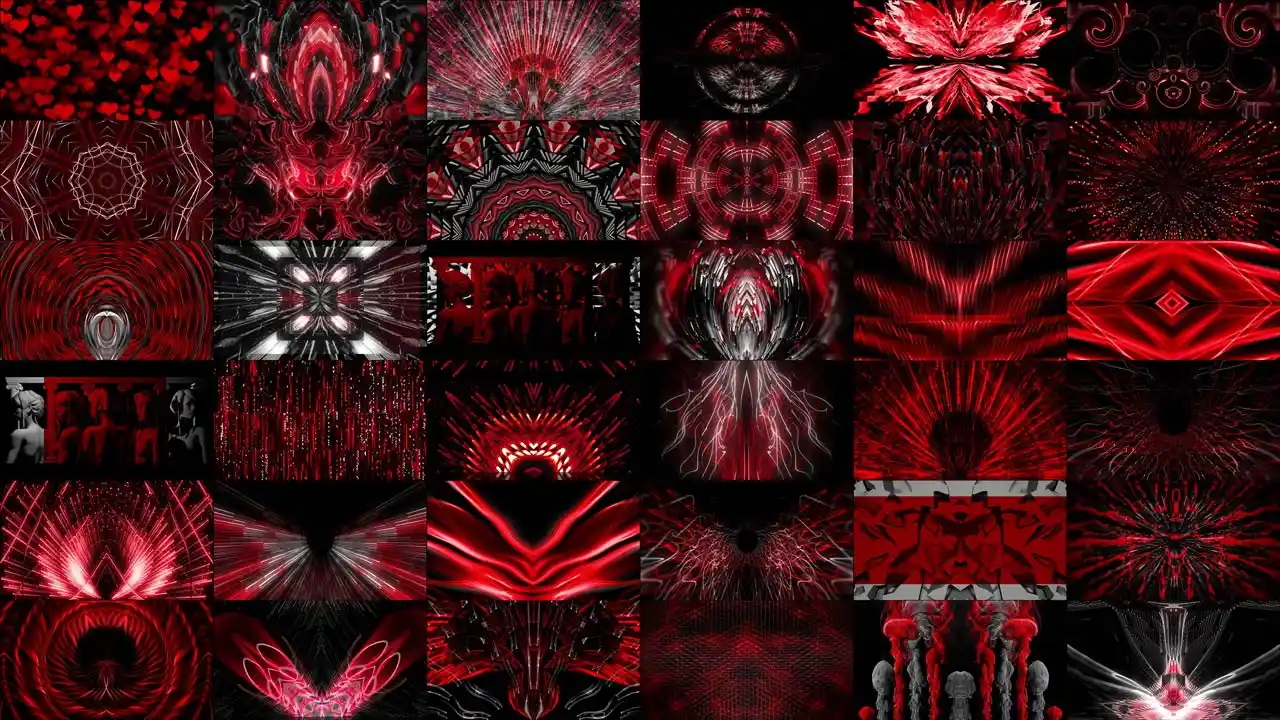
VJ Loops Pack Vol.19 – Lovely Red
79€ -
VJ Loops Pack Vol.11 – Really Madonna
89€ -
Sale!
Interior Patterns – Immersive Visuals Vol.1
Original price was: 249€.149€Current price is: 149€. -
VJ Loops Pack Vol.85 – Gnosis Lightning
99€ -
VJ Visuals Starter Pack
99€ -
Sale!

 Select options This product has multiple variants. The options may be chosen on the product page
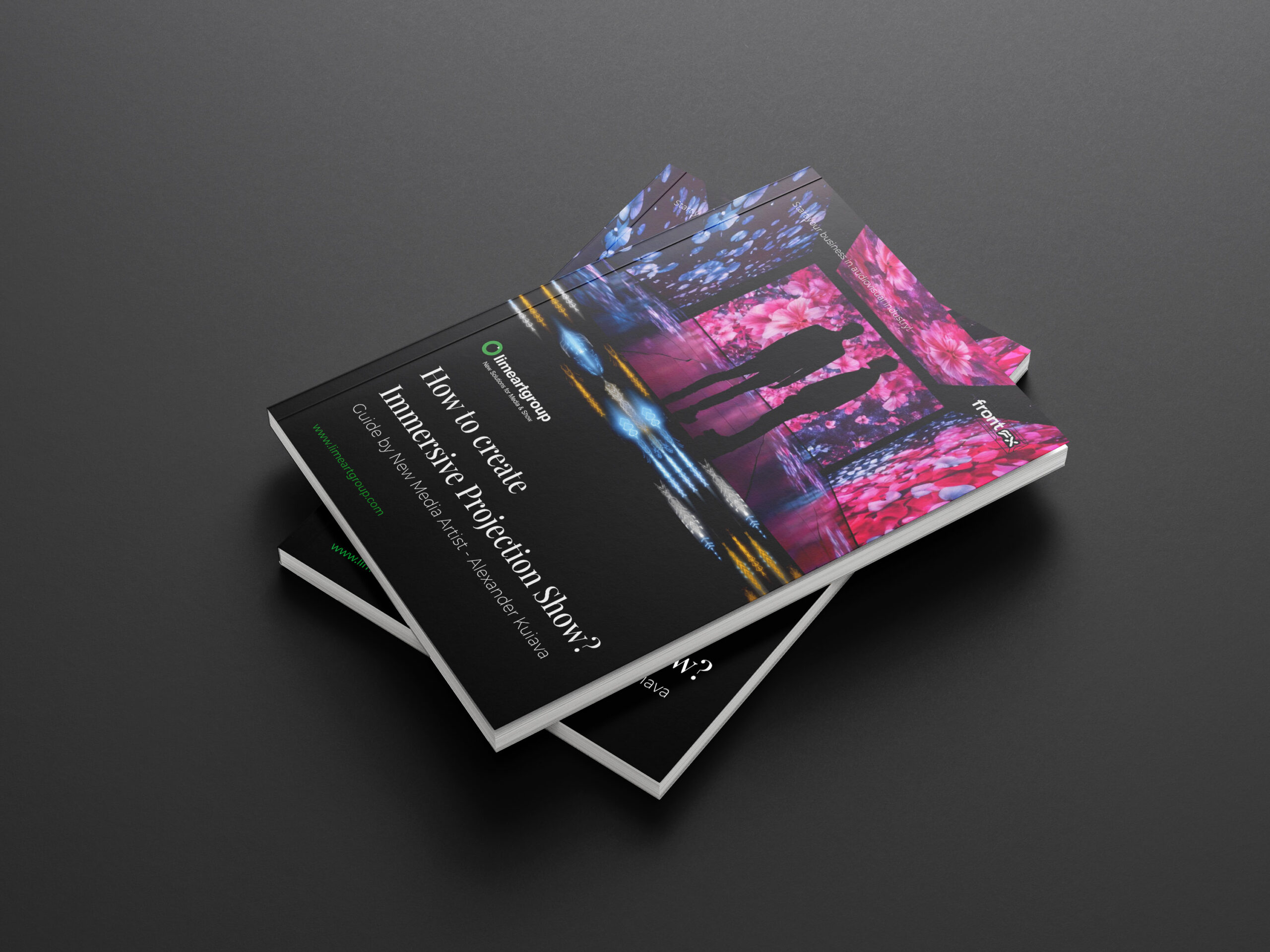
Immersive Projection Business Guide
Original price was: 19€.12€Current price is: 12€. -
VJ Loops Pack Vol.83 – Vivid Wheat
99€ -
Sale!
Green Screen Video Footage Bundle Vol.1 – 5in1
Original price was: 499€.299€Current price is: 299€.










Best wishes from Vienna,
Thanks for your attention, faithfully yours,
Alexander Kuiava – Founder & CEO LIME ART GROUP
https://alexanderkuiava.com/
